Some books exist in multiple registers simultaneously. There is The Rubaiyat of Omar Khayyam as a text — the collection of quatrains composed in eleventh-century Persia by the mathematician and astronomer Omar Khayyám, rendered into English verse by Edward FitzGerald in 1859, and subsequently translated, illustrated, printed, and bound in more editions than any comparable work of the period. And then there is the Rubaiyat as an object — specifically, as an occasion for the most ambitious decorative bookbinding in the history of the craft, the text that inspired Sangorski & Sutcliffe to produce the Great Omar, the most spectacular jewelled binding ever made, which sank with the Titanic in April 1912.
The copy we are currently offering occupies a unique position between these two registers. It is an exceptionally rare example of the Sangorski & Sutcliffe Rubaiyat in a jewelled binding set with thirty-seven stones — a volume that connects directly to the tradition of the Great Omar, produced by the same hands, in the same house, in the same period, and representing the finest expression of the jewelled binding as a living and active craft tradition.
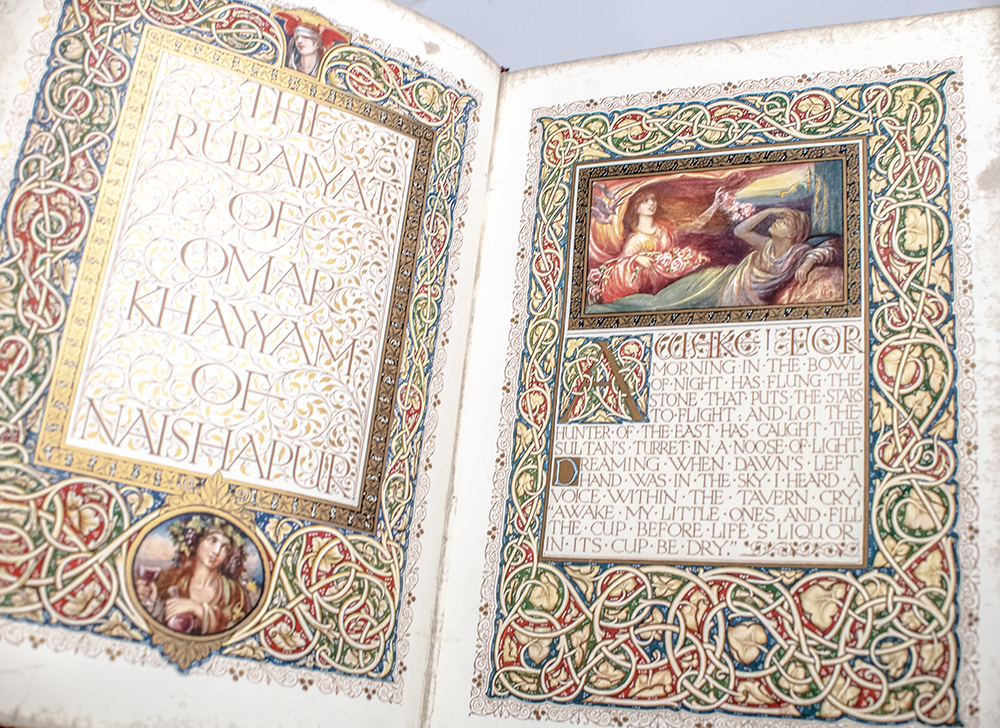
The Text and Its Translation
Omar Khayyám composed his Rubaiyat — a series of four-line stanzas meditating on pleasure, mortality, the unknowability of God, and the proper use of the time we are given — in Persia in the eleventh century. The poems circulated in manuscript for nearly eight hundred years before Edward FitzGerald encountered them in the nineteenth century and produced an English rendering of extraordinary lyric power. FitzGerald was not a strict translator — he took significant liberties with the original Persian, condensing, rearranging, and in places inventing — but the resulting text, first published anonymously in 1859, achieved a popularity that few poems in the English language have matched.
By the 1880s the Rubaiyat was read throughout the English-speaking world, and Omar Khayyam clubs had formed on both sides of the Atlantic. It became one of the defining texts of the Victorian fin de siècle — a poem about pleasure and impermanence that resonated deeply with a culture increasingly uncertain of its own foundations. Few literary texts have inspired a comparable range of illustrated and finely bound editions, and none has a more dramatic collecting history.
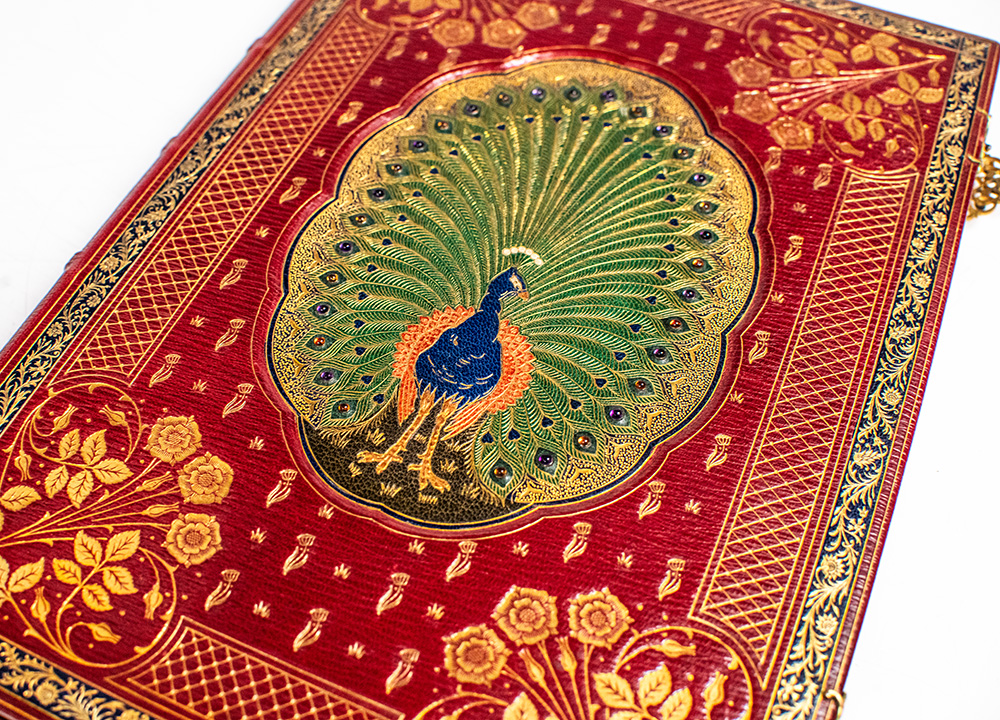
Sangorski & Sutcliffe and the Jewelled Binding
Francis Sangorski and George Sutcliffe established their London bindery in 1901 as former students of the City and Guilds bookbinding programme, and within a decade had produced work of a decorative ambition that placed them beyond any contemporary competitor. Their jewelled bindings — in which semi-precious stones are set directly into elaborately tooled leather covers, integrated into decorative programmes of peacocks, serpents, flowers, and geometric motifs executed in gold and coloured leather onlays — revived a tradition of gem-set bookbinding that had been dormant since the medieval period.
The Great Omar, commissioned in 1909 and completed in 1911, was the supreme expression of this ambition. Featuring 1,051 precious and semi-precious stones set into a design of three peacocks in full plumage on the upper cover, it was described at the time as the most ambitious bookbinding ever undertaken by any binder in history. Consigned for sale to an American collector, it was placed aboard the Titanic in April 1912 and sank with the ship. Francis Sangorski drowned in a swimming accident the same year. The Great Omar has remained on the ocean floor ever since.
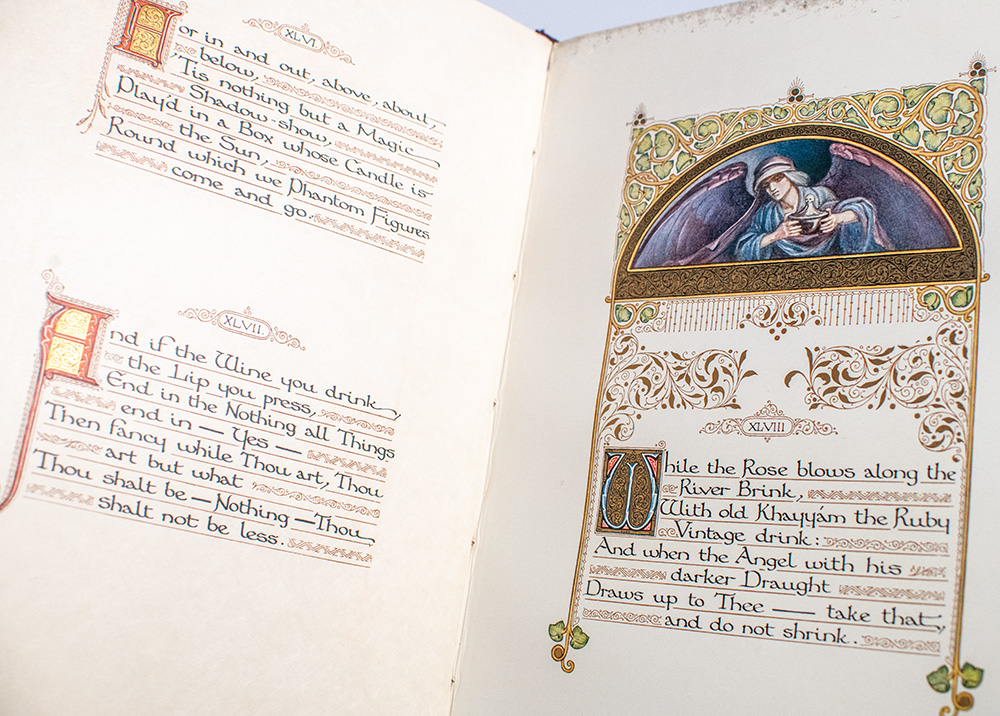
The Copy We Are Offering
This copy was produced by Sangorski & Sutcliffe from the same manuscript — reproduced from the illuminated original created by Francis Sangorski and George Sutcliffe themselves, with miniatures — and bound in their jewelled style, set with thirty-seven stones. It is a direct expression of the same tradition, the same workshop, and the same ambition that produced the Great Omar. The joints have been expertly and invisibly repaired. Laid into the front flyleaf is a one-page autograph letter signed by Elihu Vedder — the American artist whose 1884 illustrations for the Rubaiyat represent another landmark of the book’s decorative history — written to a Boston gallery owner regarding paintings for sale, dated December 16, 1868. The engraved bookplate of renowned collector William F. Gable of Altoona is present to the verso of the front endpaper. The original black and gold printed grey wrappers designed by Vedder are bound in.
This is a fine, fresh copy in a binding that stands in direct continuity with the most ambitious tradition in the history of the craft — a physical object whose beauty, rarity, and historical resonance are impossible to separate from one another. For the collector of fine bindings, it represents an opportunity of singular significance.
Contact us to enquire about this copy or to discuss the Sangorski & Sutcliffe tradition further.
You may also enjoy reading:
The Beginner’s Guide to Collecting Rare Books.
The Novel Twenty-One Publishers Rejected… and the First Edition Collectors Now Chase.
Curating a Legacy: Ten Iconic First Editions Worth Acquiring.
Nobel Laureates in Print: Collecting the First Editions of Literature’s Highest Honor.
Inside the Ancient Art of Bookbinding: How Harcourt Bindery Gives Rare Books New Life.