The Novel Twenty-One Publishers Rejected… and the First Edition Collectors Now Chase.
It is one of the great near-misses in modern publishing history. In 1953 a forty-one-year-old schoolmaster named William Golding finished a short, strange novel about a group of English boys stranded on a tropical island after a plane crash, and sent the manuscript out to find a publisher. More than twenty London houses read it. Every single one of them turned it down. By the time Faber and Faber accepted the book the following year, it had been rejected so widely that the firm’s own reader had already dismissed it – and the manuscript was rescued, almost by accident, from a slush pile by a young editor making one last sweep before the rejected pages went back into the post. The book Faber published in September 1954 was Lord of the Flies. It changed modern literature.
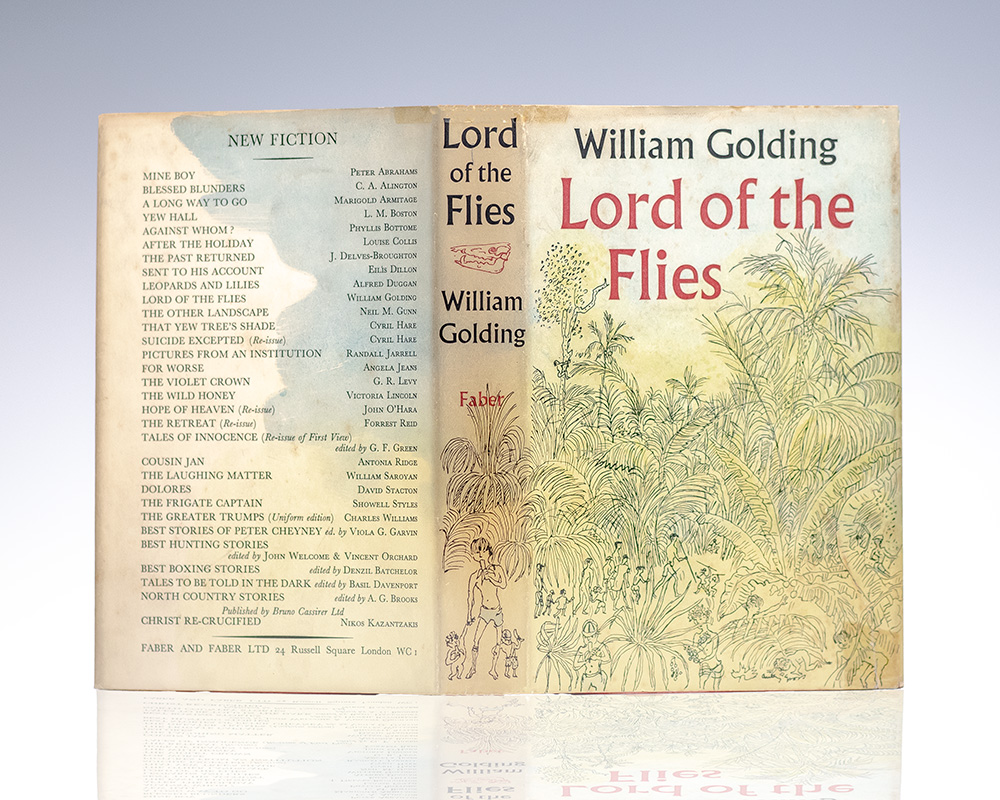
First edition of Golding’s first book, one of the best-known works in modern literature.
The Manuscript That Nearly Wasn’t Published
Golding was, in 1953, an unlikely candidate for literary celebrity. He had spent the war commanding a rocket-launching landing craft in the Royal Navy, had returned to a teaching post at Bishop Wordsworth’s School in Salisbury, and had written for years without commercial success. The manuscript he sent out under the title Strangers from Within drew on what he had seen of human behavior under pressure in wartime and on the daily theater of boys at close quarters in a school. It was bleak, allegorical, and very far from the comfortable adventure story to which its tropical setting might have seemed to nod.
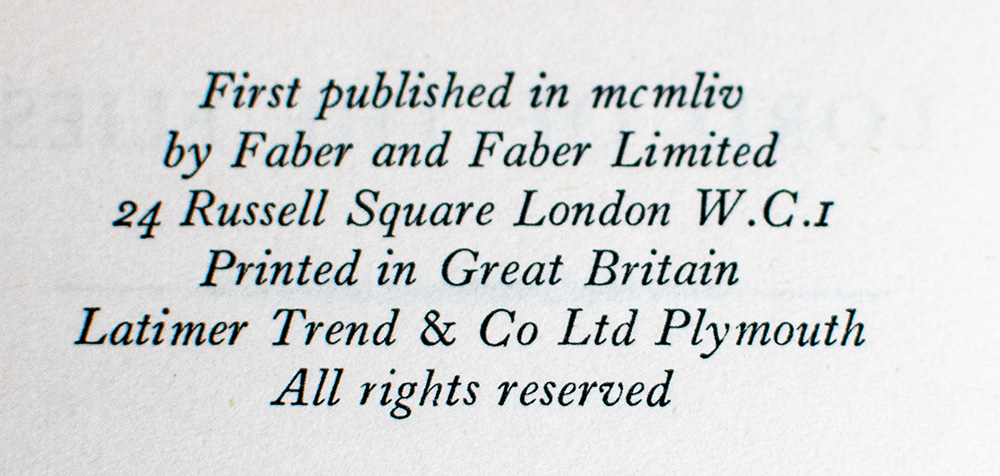
The novel reached Faber and Faber by way of an agent and was, by all accounts, on its way back out the door. Faber’s professional reader had recommended against it in unsparing terms, calling the book absurd and uninteresting. It was Charles Monteith, a young editor recently arrived at the firm, who happened to glance at the rejected typescript on his way to lunch and was arrested by what he found. Monteith took the manuscript home, read it through, and brought it back to the firm with the conviction that, with significant revisions, Faber had a book on its hands. He proposed a different title – the one Golding’s translator from Beelzebub had given him, in three small words that would soon belong to the language. He proposed cutting an extended opening scene of nuclear war that anchored the boys’ presence on the island in a too-explicit frame. He worked closely with Golding over the course of months. The result, published on 17 September 1954 in a modest first impression with a dust jacket designed by Anthony Gross, was Lord of the Flies.
A Slow Beginning, a Sudden Classic
The book did not become a sensation overnight. Reviews were respectful rather than ecstatic, sales were modest, and the first impression of just over three thousand copies was not exhausted quickly. What changed everything, in the second half of the 1950s and through the 1960s, was the schoolroom. Teachers in Britain and then in the United States found in Lord of the Flies a novel exactly suited to the moment – short enough to assign, rich enough to discuss for weeks, and unsparing in its depiction of how quickly the institutions of civilization can give way to something darker beneath. By the time the American paperback edition appeared in the late 1950s, the book was on its way to becoming one of the defining texts of postwar education.
The critical recognition followed. The New York Times praised the book as superbly written. The Modern Library named it one of the hundred greatest novels of the twentieth century. In 1983 Golding was awarded the Nobel Prize for Literature, the Swedish Academy citing the novels which, in his words, illuminate the human condition in the world of today. The book was filmed twice – by Peter Brook in 1963 in a stark black-and-white adaptation that has its own claim on the cinematic canon, and again, in a more conventional American treatment, by Harry Hook in 1990. By the closing decades of the twentieth century, Lord of the Flies had achieved the rare standing of a work both universally taught and continuously argued about, a novel as available to twelve-year-olds as it is to political theorists.
Why the First Edition Matters
The collecting market has long understood what Faber’s first reader did not. A book that survives more than twenty rejections to become a foundational work of twentieth-century literature is, by definition, a book whose earliest printed form is scarce. The London first impression of Lord of the Flies was small, the dust jackets were fragile, and the great majority of copies that have come down to the present have done so in conditions that range from sound but jacketless to worn beyond practical repair. A copy of the true first edition, in the original first-issue dust jacket, in collectible condition, is a meaningfully scarce object. A copy that bears the author’s signature is scarcer still.
First edition of Golding’s first book, near fine in a very good first-issue dust jacket. Jacket design by Anthony Gross.
Three points decide the value of a Golding first edition in the current market. The first is the jacket. The first-issue dust jacket is essential to a complete copy; later jackets and library rebackings, however clean, do not stand in for it, and a jacketless first – common in the trade – is a fundamentally different proposition from a jacketed one. The second is condition. Bright spines, complete jacket flaps with the original price intact, and clean boards are the marks of a copy that has been cared for; foxing, sunning, tape repairs, and price-clipping all reduce a copy’s standing. The third is the signature. Golding signed and inscribed books throughout his life, but signed copies of the first novel – the book that began it all – are a different category from a signed later edition, and a presentation inscription in a first edition is the most desirable form of all. Such copies pass through the trade only occasionally, and when they do they tend to move quickly.
The Copy We Are Currently Offering
We are currently offering a true first edition, first impression of Lord of the Flies, published in London by Faber and Faber in 1954, in the original first-issue dust jacket and bearing a personal presentation inscription from the author. This is the form of the book that brings together every element a serious collector of modern first editions seeks in a copy of Golding’s first novel: the earliest printed text, the original protective jacket as the book was first released, and the direct authorial association of an inscription written by Golding’s own hand. As a copy of one of the most important and most widely read novels of the twentieth century – and as the first book by an author who would go on to win the Nobel Prize – it represents a particularly desirable acquisition.
It is worth pausing, in closing, on the small accident at the center of this story. A young editor on his way to lunch happened to glance at a manuscript that had been recommended for rejection. Had he kept walking, the book would have gone back to its author with twenty-one refusals to its name, and the history of postwar literature would look measurably different. The first editions that the trade now seeks, the films, the school assignments, the Nobel Prize – all of it depended on a moment of editorial attention that very nearly did not happen. There are few better illustrations of why the first edition matters: it is, quite literally, the form in which a book enters the world, in the small number of copies that were produced before anyone yet knew what it would become.
It is one of the strangest stories in the history of modern literature. A novel rejected by every commercial publisher who saw it. A novel prosecuted for obscenity…
There is a particular category of rare book that transcends the ordinary parameters of the collecting field. These are not simply early printings of significant texts they are…
Some books exist in multiple registers simultaneously. There is The Rubaiyat of Omar Khayyam as a text — the collection of quatrains composed in eleventh-century Persia by the…
Join our growing list of satisfied clients who have leveraged
our multi-cloud and hybrid cloud strategies to achieve greater
agility and efficiency in their operations.