There is a moment every collector remembers. It might happen in a dusty antiquarian shop, at an auction preview, or while turning the pages of a catalogue. You pick up a book — really pick it up, feel the weight of the binding, study the title page — and something shifts. You are no longer simply holding a book. You are holding a piece of history.
Rare book collecting is one of the oldest and most intellectually rewarding pursuits in the world. It is also, for the uninitiated, one of the most bewildering. Where do you begin? What should you buy? How do you know if something is genuine? These are questions every serious collector has wrestled with, and the answers are more accessible than you might expect.
Start With What You Love
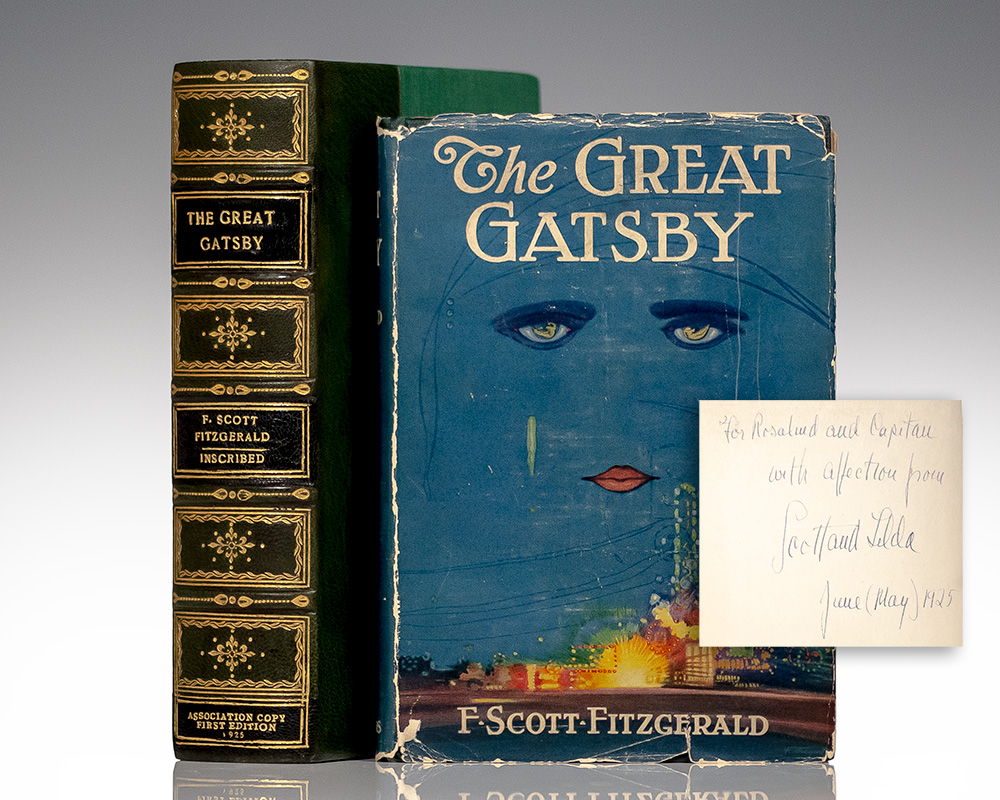
First edition, first printing of Fitzgerald’s masterpiece The Great Gatsby, inscribed by Fitzgerald to his wife Zelda’s sister and her husband and in the scarce original dust jacket
The single most reliable piece of advice any experienced collector will give you is this: collect what you love. The rare book market rewards passion. A collector who pursues first editions of twentieth-century American literature will, over time, develop an instinct for that field that no price guide can replicate. The same is true of someone drawn to natural history, travel narratives, early science, or the great works of Victorian fiction.
At Raptis Rare Books, the inventory reflects exactly this kind of depth. Whether your interest lies in a signed first edition of Ernest Hemingway’s The Sun Also Rises, a fine copy of F. Scott Fitzgerald’s The Great Gatsby, or a presentation copy of a Winston Churchill title, the collecting journey begins with a genuine connection to the material. Buy what moves you intellectually, and the collection will have coherence and character that purely speculative buying never achieves.
Understand What Makes a Book Rare
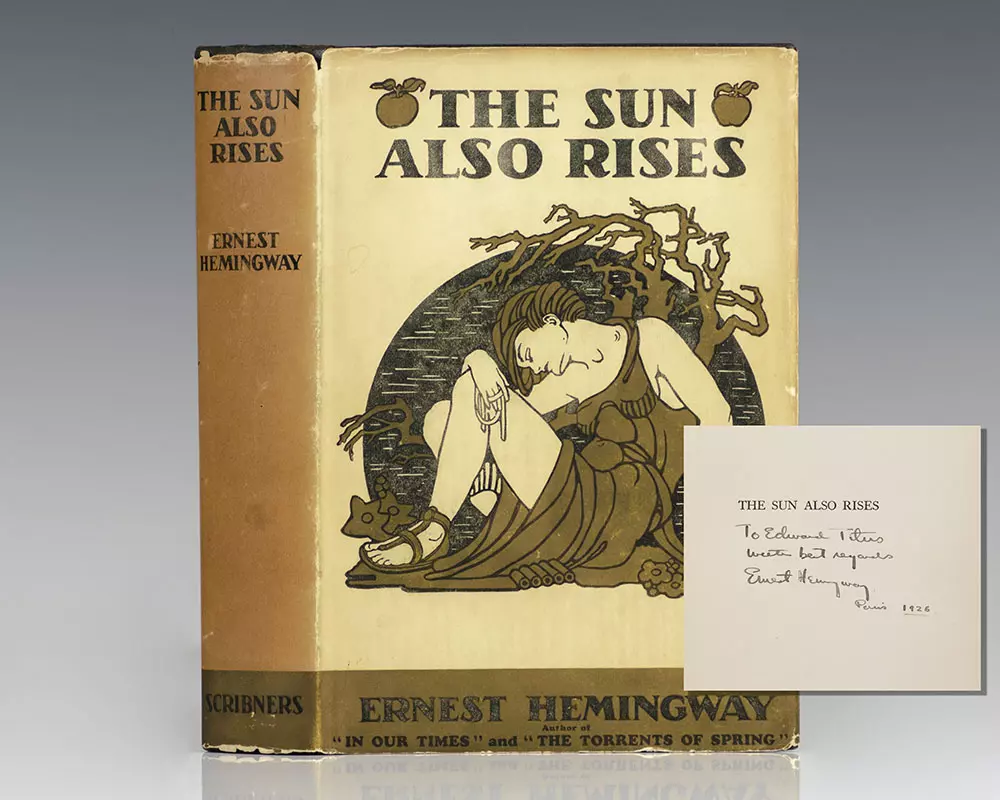
First edition of The Sun Also Rises; inscribed by Ernest Hemingway and in the scarce original dust jacket
Rarity in the book world is not simply a function of age. A seventeenth-century theological text printed in thousands of copies may be far less collectible than a 1952 first edition printed in a small run that sold poorly on publication. What collectors are really pursuing is a combination of factors: scarcity, condition, significance, and demand.
First editions are the foundation of most serious collections. A true first edition — specifically, the first printing of the first edition — is the earliest published form of a text, and for major literary works, it is the form most sought after by collectors and institutions alike. Learning to identify a first edition requires familiarity with what bibliographers call issue points: the specific typographical, binding, or dust jacket details that distinguish a first printing from later ones. A first edition of John Steinbeck’s Of Mice and Men, for example, carries specific points on the copyright page that distinguish it from the numerous later printings that followed its enormous commercial success.
Signed and inscribed copies represent another tier of desirability. A book signed by its author is more valuable than an unsigned copy, but the most prized examples go further. Presentation copies — books given by the author to a specific individual, often with a personal inscription — and association copies — books that connect two significant figures, or that carry annotations revealing the author’s own thinking — are among the most compelling objects in the rare book world. A signed first edition of Cormac McCarthy’s Blood Meridian is exceptional. A copy inscribed by McCarthy to a fellow writer, or even more so his wife, is extraordinary.
Condition is perhaps the most misunderstood factor among new collectors. In the rare book trade, condition is graded with considerable precision. A fine copy in a fine dust jacket is the standard every collector aspires to. Foxing, tanning, previous ownership inscriptions from unknown parties, and jacket tears or losses all affect value. For twentieth-century books, the dust jacket frequently represents the majority of the book’s value — a first edition of The Great Gatsby without its jacket is a fraction of the price of a jacketed copy.
Learn the Language
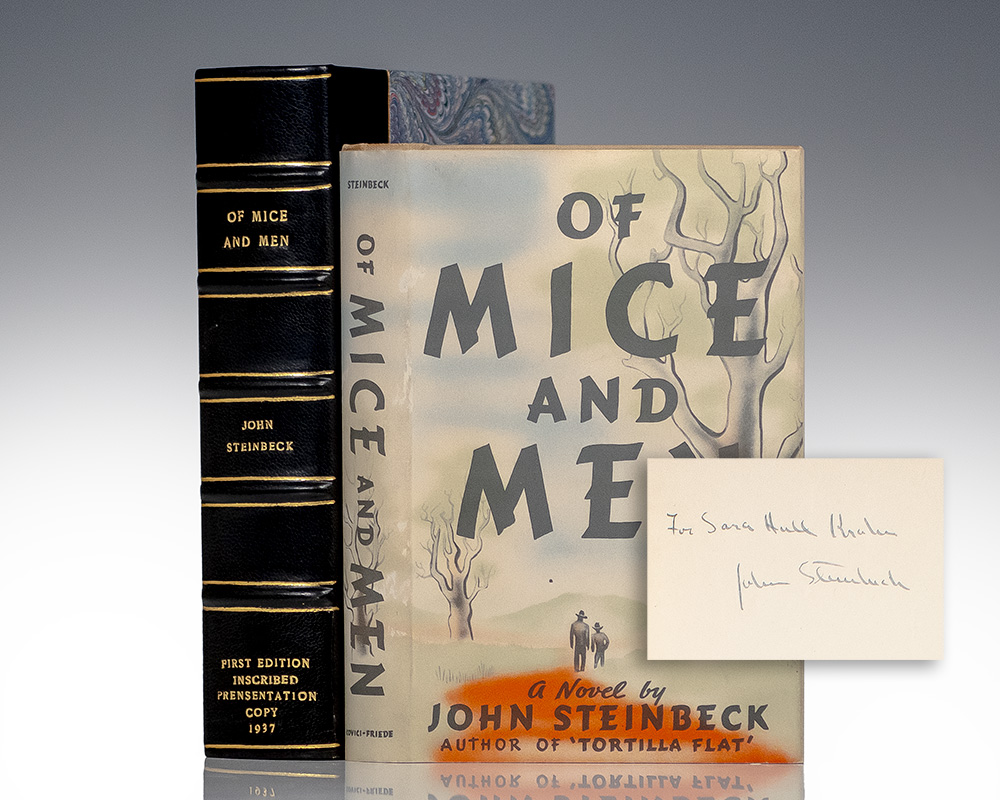
First edition, first issue of Of Mice and Men; inscribed by John Steinbeck
Every serious field has its vocabulary, and rare books are no exception. A working familiarity with the following terms will serve any new collector well.
Points — the bibliographic details used to identify a first printing. These might include a specific misprint on a given page, a particular colour of binding cloth, or a detail on the dust jacket.
Collation — the process of checking that all pages and plates are present and in order. A book described as complete or collated has been verified in this way.
Provenance — the documented ownership history of a book. Strong provenance — particularly a connection to a notable previous owner — can significantly enhance value.
Morocco — a fine leather derived from goatskin, used in high-quality bookbinding. Full morocco bindings, particularly those executed by celebrated binders such as Bayntun of Bath or Sangorski & Sutcliffe of London, are themselves collectible objects.
Incunabula — books printed before 1501, in the earliest decades of the printing press. These are among the rarest objects in the book world.
Octavo, Quarto, Folio — terms describing the size and format of a book, derived from the number of times the original printed sheet was folded.
Buy the Best Copy You Can Afford
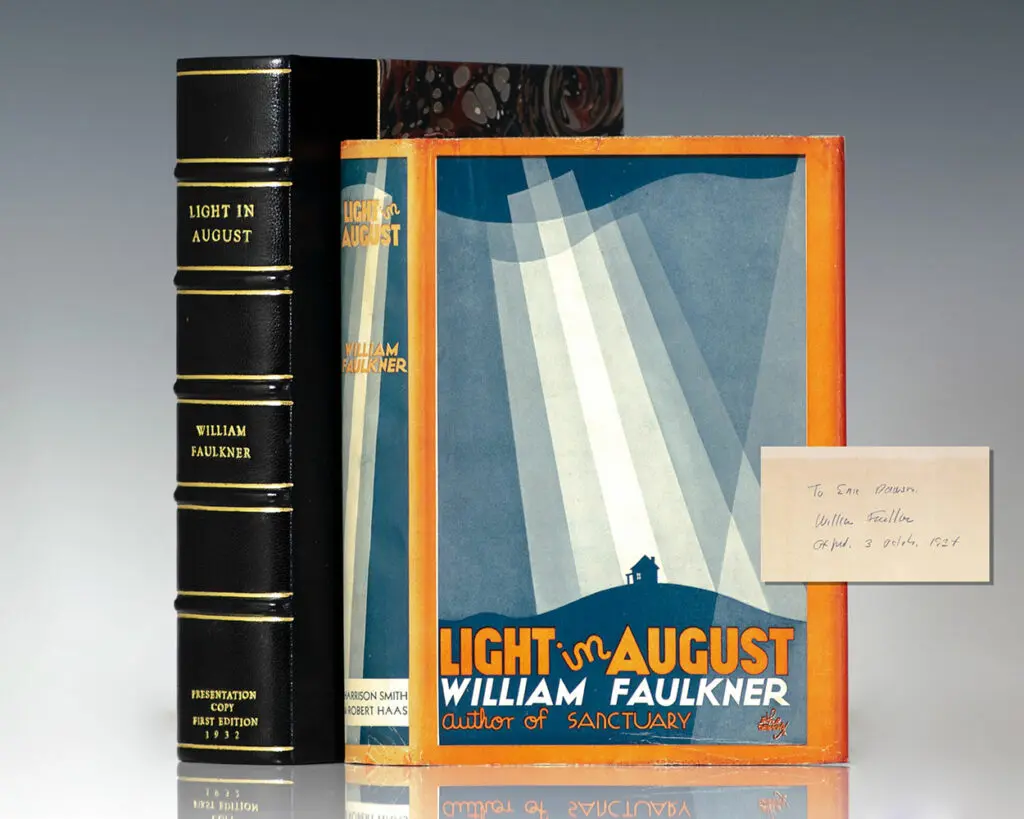
First Edition of Light In August; Inscribed by William Faulkner
This is the second great rule of rare book collecting, and it follows naturally from the first. Within whatever budget you have set, always prioritise condition. A single fine copy of a significant title will give more lasting satisfaction — and hold its value more reliably — than several compromised copies of the same work.
This is particularly true at the level of the dust jacket. New collectors frequently underestimate how dramatically jacket condition affects both value and long-term collectibility. At Raptis Rare Books, every description is precise about jacket condition, and the difference between a price-clipped jacket in very good condition and a fine, unclipped example in the same title can be considerable.
It is also worth noting that the rare book market, like any market, has cycles. Certain authors and periods move in and out of fashion. What remains consistently stable are books of genuine significance in exceptional condition. A fine first edition of a canonical work — Fitzgerald, Hemingway, Faulkner, Orwell, Woolf — has demonstrated its resilience across generations of collectors and market fluctuations alike.
Work With Reputable Dealers
Visit Raptis Rare Books on Worth Avenue in Palm Beach, Florida and allow us to assist you with building your collection
The rare book trade, at its best, is built on trust. Reputable dealers stand behind their descriptions, provide detailed condition reports, and will answer questions from collectors at every level of experience.
Raptis Rare Books has built its reputation on precisely this foundation. Each item in the inventory is carefully described, accurately graded, and offered with the confidence that comes from decades of experience in the field. For the new collector, working with a dealer of this calibre removes much of the uncertainty that can otherwise make entering the market feel daunting.
Think in Terms of a Collection, Not Just Individual Books
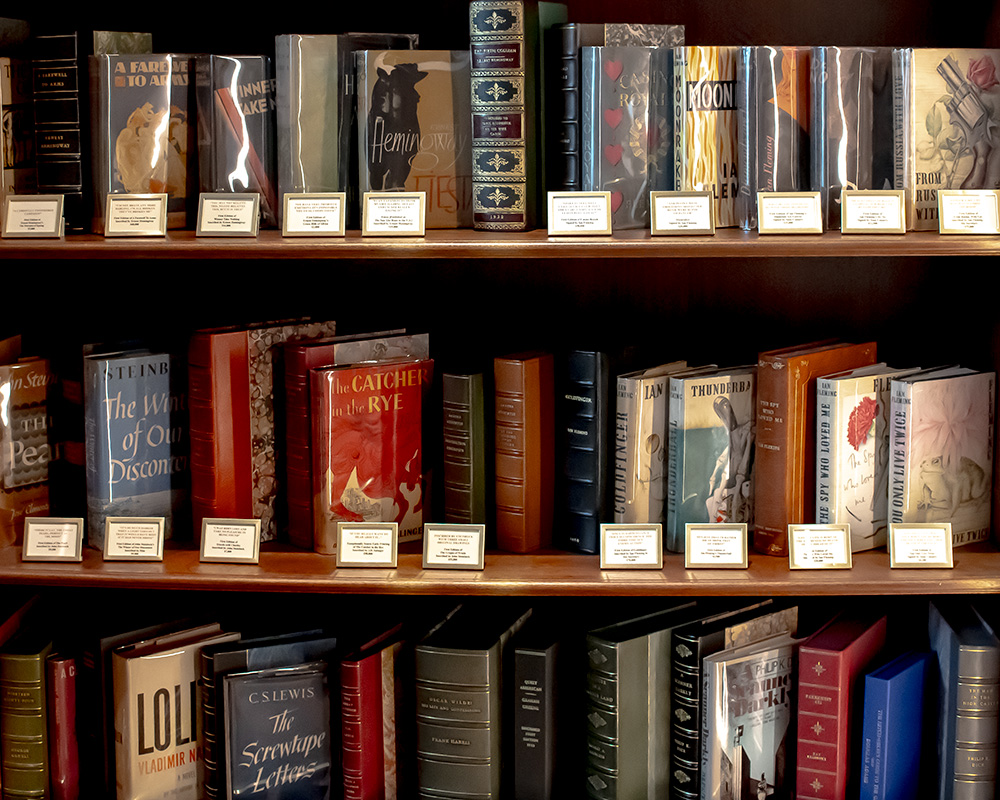
A glimpse of the modern literature collection on display at Raptis Rare Books
The most satisfying rare book collections have a point of view. They tell a story — about a period, a literary movement, a subject, or a sensibility. A collection focused on the great American novels of the twentieth century, for instance, might anchor itself with first editions of Fitzgerald, Hemingway, Faulkner, and Steinbeck, and build outward to include signed copies, association copies, and related ephemera.
This approach also tends to produce collections of greater long-term value. Institutions — libraries, universities, foundations — acquire collections that have intellectual coherence. A carefully assembled, thematically focused collection is far more likely to attract institutional interest than an accumulation of unrelated titles, however individually significant.
The First Acquisition
First edition, first issue of Mark Twain’s masterpiece Huckleberry Finn
Every collection begins with a single book. It need not be the most expensive book you will ever buy, but it should be something that genuinely matters to you — a title you would want to read, a author whose work has shaped your thinking, a subject that has held your attention for years.
At Raptis Rare Books, the inventory spans the full range of what a beginning collector might seek: from accessible signed first editions in the hundreds of dollars to significant association copies and landmark titles at the higher end of the market. The team is available to assist collectors at every stage, whether you are acquiring your first book or adding a centrepiece to an established collection.
The rare book world is patient. It rewards curiosity, careful study, and a willingness to learn. Begin with what you love, buy the best you can, and trust that the collection — and the knowledge that comes with it — will grow in ways you cannot yet anticipate.
It is one of the strangest stories in the history of modern literature. A novel rejected by every commercial publisher who saw it. A novel prosecuted for obscenity…
It is one of the great near-misses in modern publishing history. In 1953 a forty-one-year-old schoolmaster named William Golding finished a short, strange novel about a group of…
There is a particular category of rare book that transcends the ordinary parameters of the collecting field. These are not simply early printings of significant texts they are…
Join our growing list of satisfied clients who have leveraged
our multi-cloud and hybrid cloud strategies to achieve greater
agility and efficiency in their operations.