
First Edition Identification
Although it seems like it should be fairly straight forward, there is so much to know about first identification that whole books and websites are devoted to the subject. Here we will give you some basic tools to help you identify your first edition, but if would like more in-depth information, we recommend Collected Books by Allen and Patricia Ahearn or First Edition Points website.
First edition identification would be an easy task if there were only one publishing house and they remained consistent in their printing methods over the years, but alas this is far from the case. Over the years there have been thousands of publishers, each using various methods for distinguishing a first edition.
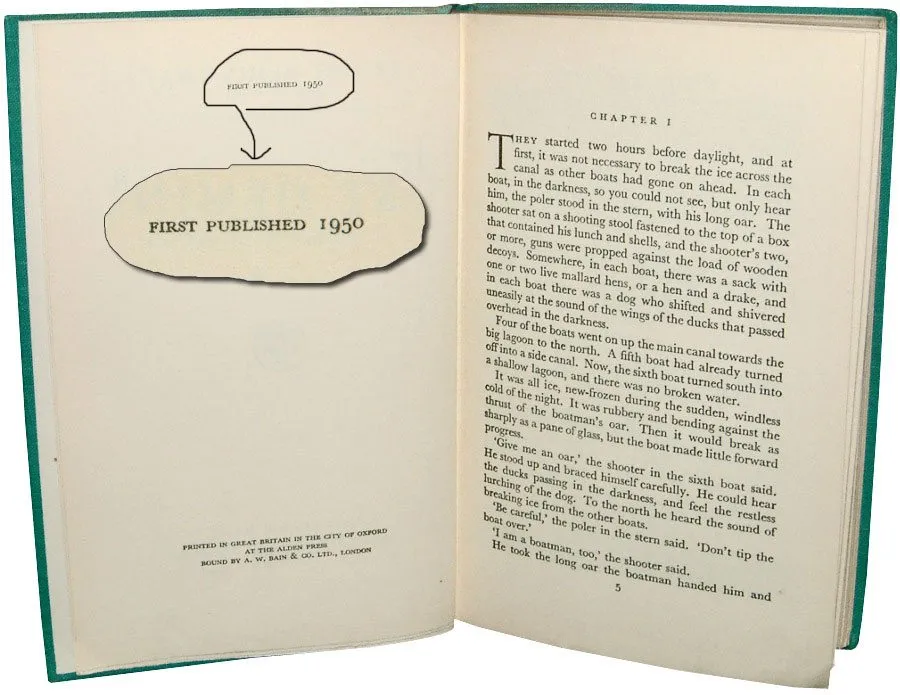
Books published prior to around 1900 are somewhat more easily identified, as publishers generally put the date on the title page of the first edition, although sometimes it can be found on the last page of the book. For more modern books, however, there began to be a trend towards putting this information on the copyright page instead. Publishers began to make statements such as “First Edition”, “First Printing”, “Published” or “First Published (followed by the year or month and year)
Then, in the last fifty years or so (but beginning as early as the 1940’s), in general, most publishers began to use some version of a number line (also referred to as a printer’s key or publisher’s code) on the copyright page, with a first printing indicated by the presence of the number 1. The following are some adaptations of number lines, all of which are first printings:
“1 2 3 4 5 6 7 8 9 10″
“10 9 8 7 6 5 4 3 2 1″
“1 3 5 7 9 10 8 6 4 2″
Let us take a moment here to tell you that any book that you purchase from Raptis Rare Books will be a first printing unless we state otherwise. This is very important, because you can be guaranteed that you are purchasing the book you want. It is unfortunate, but many sites selling collectible books state that their books are first editions, but when they arrive, they are later printings. Some publishers state ‘first edition’ on the copyright page even for later printings, so you must be aware of this as the buyer of a collectible book. For example, a copyright page that states:
First edition
4,5,6,7,8,9,10
is a fourth printing… not a first. It may even say ‘first printing’, such as the example below:
First printing
10 9 8 7 6 5 4 90 89 87 86
This, however, is again, a fourth printing, published in 1986.
The notable exception to the basic number line is Random House, who, starting in the 1970’s up until the year 2003, indicated a first printing with the statement “First Edition” and a number line beginning with 2.
The following are the methods used by some of the larger or more famous publishing houses. Overall these are general rules and there may occasionally be an exception.
Atheneum – States first edition on the copyright page and began using a number line in the mid 1980’s
Ballantine Books – Hardcover books state “First edition (Month ,Year)” or “First printing (Month, Year)” and paperback originals have no statement on the copyright page, but later printings are noted.
Bobbs-Merrill – Sometimes used a bow and arrow design on the copyright page first editions prior to the 1920’s. After the 1920’s, they usually state “First edition” or “First Printing”.
D. Appleton & Co. = Occasionally used a ‘first edition’ statement, but most often used a numerical identification, in parentheses or brackets, at the foot of the last page: “(1)” for first printing, “(2)” for second printing, etc.
Delacorte Press – Previously stated “First printing” or “First American Printing”. Now uses a number line.
Dial Press – Prior to the mid 1960’s, first printings can be identified by the same date on the title and copyright page, although they do also occasionally state “First printing”. In the late 1960’s, they began stating “First Printing (Year)” and noting later printings. They currently use a number line.
Doubleday & Co. – States “First edition” on copyright page, with no statement on later printings.
Faber & Faber, Ltd. – States “First Published (Month, Year) or (Year)” on the copyright page and notes later printings. Prior to 1968, the year of publication was in Roman numerals.
Farrar, Straus, & Giroux – States either “First published, “First printing”, or “First edition” and Year on the copyright page.
Gnome Press – States “First Edition” on copyright page, but may have occasionally left “First Edition” statement of original publisher on offset reprints with their imprint.
Gollancz (Victor Gollancz, Ltd.) – In 1984, began stating “First published in (Year)” on the copyright page of first editions. Previously, no statement had been made on first editions, but later printings were noted.
Grove Press – First editions and later printings are always noted on the copyright page. Currently uses a number line. Later-printing dust jackets are identified by a small letter code on the rear panel (ie. “ii” for second printing).
Harcourt – From 1919-1921 (called Harcourt, Brace, and Howe), usually placed the number 1 on the copyright page for first printings, 2 for second printings etc.. From 1921-1960 (called Harcourt, Brace, & Co.), they did not state first printings. In about 1931 they started putting “First Edition or “First American Edition” on the copyright page. Occasionally, through the 1940’s, they would use a “1” on the first printing. From 1960-1970 (called Harcourt, Brace, & World), they continued to state “First edition” or “First American edition”. From 1970 on (called Harcourt Brace Jovanovich), they continued this practice or placed “First Edition/ ABCDE” on the copyright page of firsts except during the years 73-83, when they did not use “A” but instead used “First Edition/BCDE”.
Are you confused yet? Wait… it gets better…. (or should we say more confusing?)
Harper (Harper & Brothers) – Prior to 1912, the date on the title page should match the last date on the copyright page. In 1912, they began including a letter code for the month and year the book was printed, which would actually be earlier than the official publication date. For the months, A= January, B= February, C=March, D= April, E= May, F= June, G= July, H= August, I= September, K= October, L= November, M= December (They skipped the letter J in both the month and year just to make it extra confusing and then started with the letter M just to mess with your head)
| 1912 = M | 1920 = U | 1928 = C | 1936 = L | 1944 = T |
| 1913 = N | 1921 = V | 1929 = D | 1937 = M | 1945 =U |
| 1914 = O | 1922 = W | 1930 = E | 1938 = N | 1946 = V |
| 1915 = P | 1923 = X | 1931 = F | 1939 = O | 1947 = W |
| 1916 = Q | 1924 = Y | 1932 = G | 1940 = P | 1948 = X |
| 1917 = R | 1925 = Z | 1933 = H | 1941= Q | 1949 = Y |
| 1918 = S | 1926 = A | 1934 = I | 1942 = R | |
| 1919 = T | 1927 = B | 1935 = K | 1943 = S |
In 1922, they began stating “First Edition” as well, but also used the above coding system until 1949. In 1962, they became Harper and Row. They began to use a number line to the bottom of the last page but often failed to remove the “First Edition” statement from later printings. In 1975, they began using a number line on the copyright page… again often failing to remove the “First Edition” statements from later printings. In 1990, they changed the name again to Harper Collins, but nothing changed regarding their first edition identification … including forgetting to remove the “First Edition” statements from later impressions.
Harvard University Press – The year of publication is printed on the title page of first editions, whereas it is removed from later printings and a notice has been added to the copyright page. They began using a number row in the 1980’s.
Heinemann (William Heinemann) – From 1890 to 1921, they placed the year of publication on the title page of first editions, removing it for later printings and adding a notice on the copyright page. In the 1920’s, they began stating “First published (Year) or First published in Great Britain (Year) on the copyright page of first editions and continued to note later printings.
Holt, Rinehart & Winston – Before the 1970’s, most often used a first edition statement and after the 1970’s, a first edition statement and a number line.
Houghton, Mifflin – Usually puts the date in Arabic numerals on the title page of first printings and removes it from later printings. In the 1950’s they also began adding a “First printing” statement on the copyright page, which they later replaced with a number line in the 1970’s.
Jonathan Cape – “First published (Year)” or “First published in Great Britain (Year)” statement on the copyright page of first editions, with later printings noted.
Knopf (Alfred A. Knopf) – Until around 1934, they sometimes stated “Published (Year or Month and Year)” on the copyright page of first editions, with later printings noted. After that time, they have consistently stated “First Edition” (with the exception of some children’s books). Books with “First and second printings before publication” are second printings.
J.B. Lippincott – Starting in about 1925, they sometimes included first edition statements on the copyright page but always indicated later printings. In the mid 70’s, they added a number line.
Little, Brown – Before the early 1930’s, there is no first edition statement, but later printings are noted. In the 1930’s began stating “Published (Month) (Year)” on the first edition copyright page. In 1940, started stating “First Edition” or “First Printing” and then added a number line in the late 1970’s.
Macmillan Co. – (U.S.) In 1936, began stating “First printing” on the copyright page. In the 1970’s they added a number line. (U.K.) In the mid 1920’s, they began to state “First Published (Year)” on the copyright of first editions, with later printings noted.
McGraw-Hill – Began using a first edition statement in 1956.
Modern Library – Reprint series acquired by Random House from Boni & Liveright in 1925, at which time they began stating “First Modern Library Edition” on the copyright page of the first edition. Occasionally, they accidentally left the first edition statement on later printings.
Oxford University Press – Until the late 1980’s, there was no first edition statement, however, later printings were noted.
Pantheon Books, Inc. – In 1964, began stating “First Edition”, along with later printings being noted. They started using a number line, as well in the late 1980’s.
Random House – States “First Edition” on the first printing, but does not indicate subsequent printings. In the 1970’s, they added a number row beginning with the number 2 and removed the first edition statement from later printings.
Scribners – Until 1930, the Scribners seal and date of publication (Month and Year) appeared on first editions, with later printings usually noted (although not always). After 1930, they used an “A” on the copyright page to denote the first edition along with the seal or with a code representing the month and year of publication and the book’s manufacturer. Later printings were either not noted or indicated with a “B”, “C”, etc. In the 1970’s, they added a number line, which also includes a letter code for the manufacturer and type of binding.
Scholastic Press – For collectors of American editions of books such as the Harry Potter series or the Hunger Games trilogy, here is information on identifying your edition.
For print information there should be numbers like these on the copyright page:
10 9 8 7 6 5 4 3 2 1 6 7 8 9 0/0
The numbers on the left indicate the printing (i.e. 1st printing, 2nd printing, 3rd printing, etc).
So, a second printing would look like this: 11 10 9 8 7 6 5 4 3 2
A third printing like this: 12 11 10 9 8 7 6 5 4 3
And a fourth printing like this: 13 12 11 10 9 8 7 6 5 4
The numbers on the right indicate the year the book is being printed. Reprints happen over a period of years. So the numbers above would indicate a 1996 printing.
7 8 9 0/0 . . .would indicate 1997
8 9 0/0 . . .is 1998
9 0/0 . . .is 1999, etc.
Secker & Warburg – In the 1940’s, they began stating “First published in (Year)” on the copyright page of first editions and noting later printings (which they also did prior to the 1940’s)
Simon & Schuster – In 1952, they began using a first edition statement and in the 1970’s, a number line. They have always noted later printings (occasionally with symbols).
Vanguard – No first edition statement and sometimes failed to note later printings. In the 1970’s, they started using a number row, although some titles in the mid 80’s are missing this.
Viking Press – In 1937, they began stating “First Published by Viking in (Year)” or “Published by Viking in (Year) on first editions and noted later printings. In the 1980’s, they added a number line only to later printings.
Wiley (John Wiley & Sons) – Prior to 1969, no first edition statements but subsequent printings are noted. Since 1969, they have used a number line.
William Morrow – Before 1973, they usually placed “First Printing (Month, Year)” on the copyright page, and always indicated later printings. After 1973, they began to use a number line and sometimes a first edition statement (which they occasionally failed to remove from later printings).