
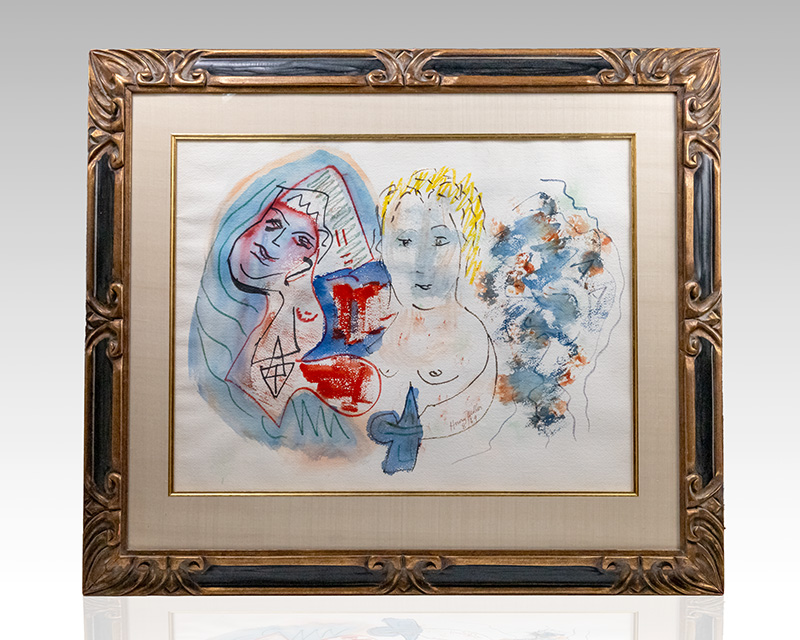
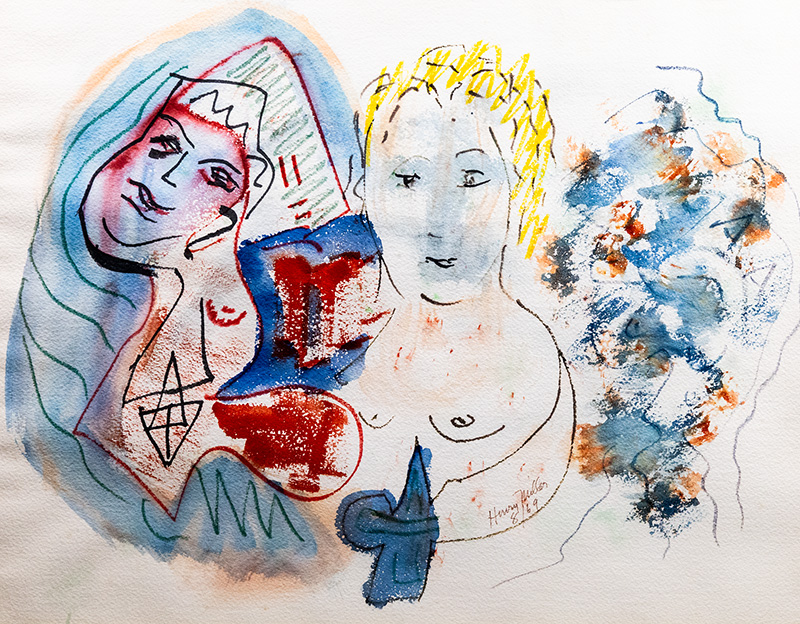
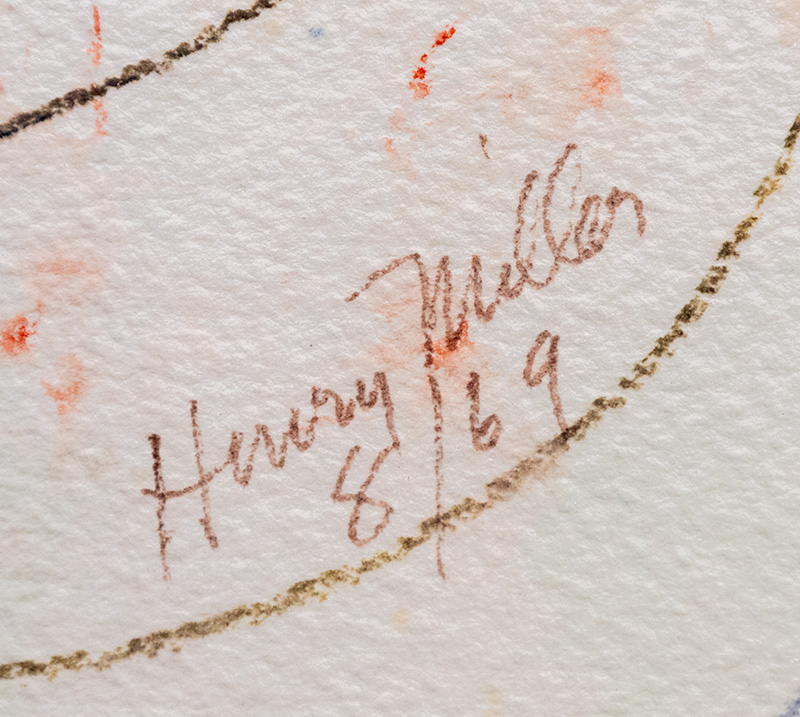
MILLER, Henry.
Henry Miller Original Watercolor Painting.
To read Miller without his watercolors is to miss something essential. The two practices were never separate compartments of a versatile temperament. They were one continuous act of attention, carried out in different mediums. Miller came to both arts late and by improvisation. Born in 1891 and raised in the Williamsburg section of Brooklyn, he spent his twenties and early thirties in a succession of jobs—Western Union personnel manager being the longest and most despised—and a first marriage that left him restless and unsure of his vocation. He read voraciously and idiosyncratically: Whitman, Emerson, Dostoevsky, Knut Hamsun, Élie Faure. He wrote and discarded several manuscripts. He did not yet know how to put a sentence together with the unmistakable rhythm that would later carry his name.
The watercolors began in this same period of indecision. The story Miller liked to tell—and like most of his stories, it has the burnish of frequent telling—is that he sat down one day with a child's paintbox and began to make pictures with no instruction whatsoever. He did not study composition. He did not enroll in a class. He simply painted, with the same mixture of immersion and bravado that he would later bring to the books. Painting and writing entered his life through the same door: as practices of self-discovery undertaken without permission.
In 1930 Miller arrived in Paris with almost no money and stayed nearly a decade. The years he describes in Tropic of Cancer—hunger, walking, talk, the cafés and the borrowed beds—were also the years in which his prose finally became his own. Tropic of Cancer was published in 1934 by Jack Kahane's Obelisk Press, in the familiar soft wrappers and with the warning that it was not to be imported into England or the United States. Black Spring followed in 1936 and Tropic of Capricorn in 1939. The voice of these books—rhapsodic, profane, philosophical, comic, and unembarrassed—was unlike anything else being written in English.
What is sometimes overlooked is that Miller went on painting throughout these Paris years. He painted at café tables and on hotel desks. He gave watercolors away to friends and bartenders. He included an essay on his painting practice—"The Angel Is My Watermark!"—as a chapter of Black Spring, a piece in which he describes the abandon of the act with the same comic seriousness he brought to his accounts of writing. The essay is one of the more memorable pieces of prose ever written about the act of painting by someone the art world had not yet recognized as a painter, except that Miller was already, by the standards he cared about, a painter.
When Miller returned to the United States in 1940 and eventually settled at Big Sur in 1944, the watercolors took on an even larger place in his daily life. He often wrote in the morning and painted in the afternoon. He hung them on the walls of his cabin. He sent them to correspondents in lieu of letters. He sold them when he needed money, sometimes for a few dollars, sometimes traded for groceries and supplies. The habit of giving them away, casually and without ceremony, became part of the texture of his Big Sur years.
The publications on painting accumulated. The Waters Reglitterized, a small treatise on the watercolor practice, appeared at mid-century. To Paint Is to Love Again, which gathers his thinking on the discipline with the directness of a man addressing what he loves most, appeared in 1960. Insomnia, or the Devil at Large, published late in his life, recounts a sleepless period during which he produced a series of watercolors as the only solace the hours offered him. Across these books a consistent attitude emerges. Miller refuses to treat painting as either an amateur indulgence or a secondary art. He treats it as a vocation.
His refusal was more than rhetorical. The watercolors themselves have steadily found their audience. They were exhibited during his lifetime in the United States, in Europe, and in Japan, and the major collections of them have continued to be shown and published in the decades since his death.
Miller was one of those writers who becomes a critic in spite of himself, and his pages on painting amount to a quiet, consistent aesthetic. He believed that the act of painting was a form of prayer—a phrase he used without irony. He believed that one should paint as a child paints, without the burden of knowing better. He believed that mistakes were not to be erased but absorbed, that the watercolor's accidents were among its great virtues, and that the painter's task was to remain receptive rather than to assert mastery.
These convictions are not incidental to his prose. The same trust in accident, the same suspicion of the corrected and the polished, the same preference for flow over architecture, governs the structure of Tropic of Cancer and Black Spring. Miller's books proceed by association rather than plot. They take their shape from the rhythm of the sentences and the sudden swerves of the speaker's attention. They share, in other words, the method of his watercolors. The two practices clarify each other. To understand what Miller meant by writing, one has to understand what he meant by painting; and vice versa.
He once wrote that to paint was to love again. The phrase is sentimental in the way Miller could be when he was telling the truth. He meant, among other things, that painting returned him to a state of unguarded attention to the world that ordinary life conspires against. The books had the same purpose.
Henry Miller Original Watercolor Painting.
Other Books by this Author


