In the News: WPB Library Foundation Yacht Cruise Has Record-Breaking Year
(WEST PALM BEACH, FL) – The West Palm Beach Library Foundation’s Cruise for a Cause set new records in number of guests aboard the yacht and in achieving…
Read moreArthur Koestler was born in Budapest on the fifth of September, 1905, and by the time he died in London seventy-seven years later he had produced one of the strangest and most consequential literary lives of the twentieth century. Journalist, communist, Zionist, escaped prisoner of Franco’s Spain, refugee, ex-communist, novelist, essayist, historian of science, prophet of the paranormal, and eventually a suicide alongside his wife in a joint pact that shocked literary London, Koestler lived out in a single career very nearly every intellectual current of his century. But it is on the strength of one novel, published in London in December 1940 under the title Darkness at Noon, that his place in literature was fixed. On what would have been Koestler’s 121st birthday, it is worth pausing over that book, and over the small trilogy of political novels of which it is the center.

A Novel Almost Lost to History
Koestler wrote Darkness at Noon in Paris between the summer of 1938 and the spring of 1940, in German, under a working title that translates as Rubashov, the name of its protagonist. He was thirty-four, recently and painfully broken with the Communist Party, and living in the crowded refugee circles of the last months of the French Third Republic. Alongside him, sharing the small Paris apartment and the daily work of the book, was the young English sculptor and translator Daphne Hardy, who was rendering each finished chapter into English almost as quickly as Koestler could write it. Neither of them, in the spring of 1940, could have known that the English version she was producing would soon be the only version left in the world.
The Wehrmacht crossed the French border in May of that year. Koestler, as an anti-Nazi refugee holding suspect papers, was interned by the French authorities. Hardy, in the chaos of the fall of Paris in June, fled the city with what she could carry. What she carried was the English typescript. Koestler’s original German manuscript did not survive the war. For more than seven decades, Darkness at Noon existed only in Hardy’s translation, and the “original” text was in effect an English one — a translation from a lost original, published as though it were the primary work. Only in 2015 was a copy of the German typescript recovered from a publisher’s archive in Zurich, and only in 2018 was the German Rubashov finally published, seventy-eight years after Koestler had first set it down. It is one of the strangest publication histories in modern literature.
Jonathan Cape brought out the English Darkness at Noon in London in December 1940, a matter of months after Hardy had reached England with the typescript in her luggage. The Macmillan Company issued the first American edition in New York the following year, in 1941. Both editions found readers immediately, and within a decade the book had been recognized as one of the small handful of novels that would define how the twentieth century remembered itself.

Rubashov’s Cell
The novel tells the story of Nicholas Salmanovitch Rubashov, an Old Bolshevik and former Commissar of the People who is arrested by the very Party he helped to build and imprisoned in a cell not unlike the cells his own testimony had once filled. Rubashov’s interrogators are two younger Party men, one an old comrade of his own generation and one a rising officer of the new order, and the book unfolds as the extended conversation between the prisoner and his questioners, interrupted by Rubashov’s own memories of the doctrinal choices, the friendships betrayed, and the lives destroyed in the name of the historical necessity in which he had once so completely believed. The novel is set in an unnamed country, ruled by an unnamed dictator whom the text refers to only as “Number One,” and the reader is never told in so many words that the setting is Stalin’s Moscow. It does not need to be told. The Moscow show trials of the late 1930s stand behind every page.
What Koestler achieved in the book was something no earlier novelist had quite managed: a portrait of a totalitarian regime rendered from inside the mind of one of its true believers. Rubashov is not a martyr, and he is not a hero. He is a man who had, for the sake of the revolution, done to others what is now being done to him, and who, in the long nights of his imprisonment, is forced to confront the logic he had spent his life defending. The novel’s terrible power lies in the honesty of that confrontation, and in the recognition, arrived at page by page, that the logic will not hold.

Alongside Orwell
It is difficult, today, to read Darkness at Noon without also thinking of Animal Farm and Nineteen Eighty-Four, and this is no accident. George Orwell read Koestler with close attention and reviewed him more than once, and Koestler read Orwell. The three novels — Koestler’s of 1940, Orwell’s of 1945 and 1949 — form the founding sequence of the modern anti-totalitarian novel in English, and they were understood as such almost from the moment the last of them appeared. Orwell’s own admiration for Koestler was direct: he called Koestler’s later novel Arrival and Departure, the closing volume of the trilogy on offer here, the source of “one of the most shocking descriptions of Nazi terrorism that have ever been written.”
The three books do slightly different work. Animal Farm is fable; Nineteen Eighty-Four is dystopia. Darkness at Noon is neither. It is a realist psychological novel of the interior life of a broken idealist, and its argument is delivered not in allegory or in projection but in the specific voice of a man who has lived the whole history he is now being asked to renounce. Where Orwell writes to warn, Koestler writes to reckon. Both modes have their necessity and the century required them equally.

The Trilogy
Koestler himself did not, at the outset, plan the three novels as a trilogy. It was only after the publication of Arrival and Departure in 1943 that he declared his first three novels to form a thematic sequence, unified not by narrative continuity but by a single sustained inquiry into the ethics and consequences of revolutionary politics. Read in order, the trilogy traces the arc of an entire disillusionment.
The Gladiators, published in 1939, is the first of the three. On its surface it is a historical novel about the slave uprising of the Thracian gladiator Spartacus in the last century of the Roman Republic. Beneath the surface it is a study of the corruption of a revolutionary movement by the requirements of its own success, and Koestler’s Spartacus is a figure whose failures the reader is invited, unmistakably, to read forward into the twentieth century. Darkness at Noon, published the following year, brings the argument into the present. And Arrival and Departure, published in 1943, brings it into Koestler’s own biography, following a young Central European refugee through the moral crises of exile, resistance, and the impossibility of neutrality in wartime Europe. The three books, taken together, are one of the most sustained meditations on twentieth-century political conscience produced by any novelist of Koestler’s generation.

The Copy We Are Currently Offering
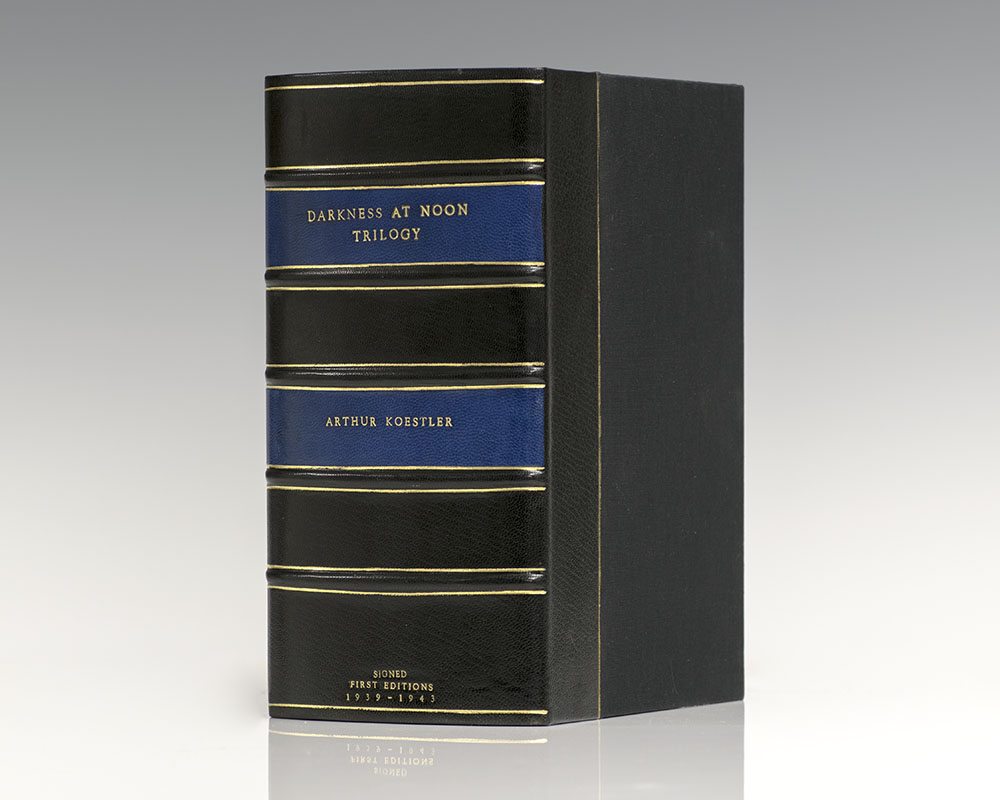
We are pleased to have on the shelf a complete set of first American editions of Koestler’s trilogy — The Gladiators (Macmillan, 1939), Darkness at Noon (Macmillan, 1941), and Arrival and Departure (Macmillan, 1943) — with Darkness at Noon signed by Arthur Koestler on the front free endpaper. Each volume is very good in a very good dust jacket, and the set is housed in a custom half morocco clamshell box made by our own Harcourt Bindery in Charlestown, Massachusetts, built to the standard the books deserve and to protect them for the next century.
Signed first American editions of any of Koestler’s novels are uncommon, and signed copies of Darkness at Noon in particular are genuinely scarce in the trade. The book was not one Koestler signed casually or often, and a copy of the American first with the author’s hand on the endpaper is the kind of copy that tends to appear only rarely on the market. Presented as a matched trilogy, in the original jackets, housed in a bespoke clamshell, and anchored by the signed Darkness at Noon, this is as complete a Koestler set as a serious collector of twentieth-century political fiction is likely to encounter.a
The set is priced at $12,000 and is available at the gallery on Worth Avenue and at raptisrarebooks.com.
Koestler’s birthday is a good occasion to remember what the book on the shelf actually is. Darkness at Noon was written in a language whose original manuscript did not survive, by a refugee whose freedom depended on a young translator’s presence of mind, in the last months of a Europe that was about to disappear. It was published a year into the Second World War, at a moment when the argument it made was easy to miss under the weight of the news. It has since been translated into more than thirty languages, and read by generations of readers who had never lived under either of the regimes it was written to describe. On the shelf, it is not much more than a small twentieth-century novel in a modest first-edition binding. In the history of the century, it is one of the books that helped teach the free world how to recognize what it was up against.

Browse our current inventory of modern first editions, where this signed Koestler trilogy joins a wider holding of the foundational works of twentieth-century literature, or be in touch with the gallery directly to discuss the books you would most wish to add to a collection of your own.
You may also enjoy reading:
The Legacy of Allen Ginsberg: Howl and the Voice of the Beat Generation
Gabriel García Márquez: Master of Magical Realism
Curating a Legacy: Ten Iconic First Editions Worth Acquiring
(WEST PALM BEACH, FL) – The West Palm Beach Library Foundation’s Cruise for a Cause set new records in number of guests aboard the yacht and in achieving…
Read moreArthur C. Clarke’s 2001: A Space Odyssey was written in an unusual way—hand in hand with the film it accompanies. Beginning in 1964 from Clarke’s 1948 short story…
Read moreMeet Fox News Channel’s Chief Breaking News Correspondent Trace Gallagher at an exclusive book signing event celebrating the launch of his highly anticipated new book, Turns Out They…
Read more