The Intellectual Legacy of The Wealth of Nations: How Adam Smith Defined Modern Economics.
In 1776, two revolutions entered the world through the printed page. One declared political independence in North America through the publication of the Declaration of Independence. The other introduced a radically new framework for understanding economic life: An Inquiry into the Nature and Causes of the Wealth of Nations by Adam Smith.
While the political revolution reshaped the structure of governance, Smith’s work initiated an intellectual transformation in how societies understood wealth, production, and markets. Today, nearly two and a half centuries later, The Wealth of Nations remains one of the foundational texts of modern economic thought.
First edition of Adam Smith’s magnum opus An Inquiry into the Nature and Causes of the Wealth of Nations; published in 1776
The Mercantilist World Smith Challenged
Before Smith’s intervention, European economic policy was largely guided by mercantilism, a doctrine that equated national prosperity with the accumulation of precious metals such as gold and silver. Governments pursued policies designed to maximize exports, restrict imports, and acquire colonial resources. Wealth, in this framework, was understood as a finite stock of bullion that nations competed to possess.
Smith fundamentally challenged this assumption. In The Wealth of Nations, he argued that wealth is not primarily stored in metal reserves but generated through productive activity. According to Smith, the true wealth of a nation lies in its capacity to produce goods and services through labor, specialization, and voluntary exchange.
This conceptual shift—from treasure to productivity—altered the intellectual trajectory of economic policy. Wealth became associated not with hoarded resources but with the dynamic processes of production and trade.
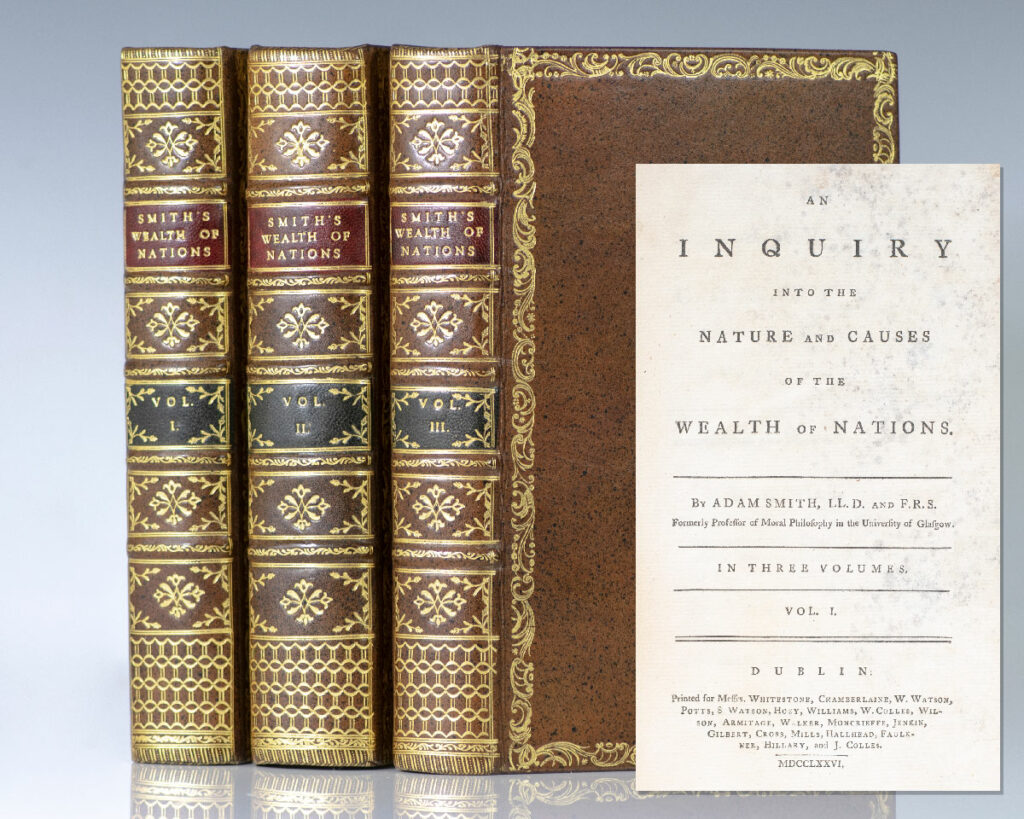
First Dublin edition of An Inquiry into the Nature and Causes of the Wealth of Nations; published the same year as the first
The “Invisible Hand” and Market Coordination
One of the most famous ideas associated with Smith is the notion of the “invisible hand.” Interestingly, the phrase appears only once in The Wealth of Nations. Despite its limited textual presence, the concept has become one of the most widely cited metaphors in economics.
Smith suggested that individuals pursuing their own interests within competitive markets may unintentionally contribute to broader social prosperity. Through decentralized decision-making and exchange, market systems can coordinate production and distribution without centralized planning.
The idea has remained central to debates about economic organization for more than two centuries. Discussions about free markets, government regulation, trade policy, and tariffs often trace their intellectual lineage back to Smith’s original formulation.
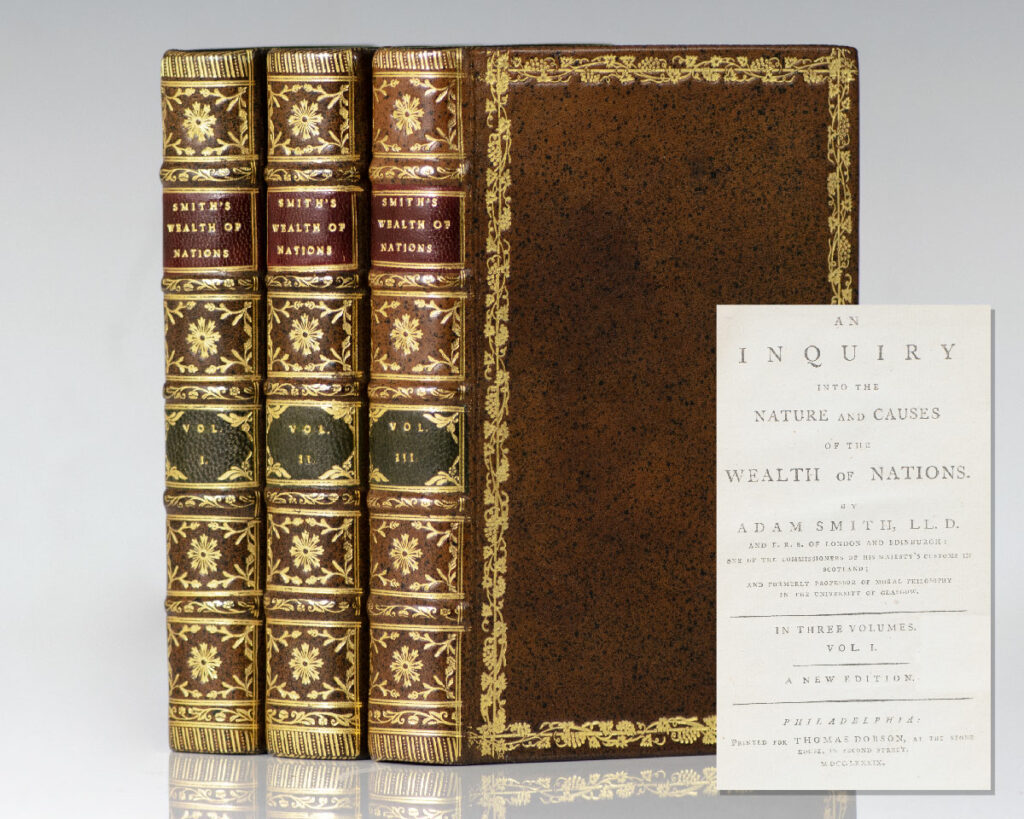
First American edition of Adam Smith’s An Inquiry into the Nature and Causes of the Wealth of Nations; published in 1789
The Division of Labor
Perhaps the most influential analytical concept introduced in The Wealth of Nations is the division of labor. Smith illustrated this principle through a now-famous example: a small pin factory.
If a single worker attempted to produce pins independently—performing every step of the process—the output would be minimal. However, when production is divided into specialized tasks and distributed among multiple workers, total output increases dramatically. Smith observed that ten workers specializing in different stages of pin production could collectively manufacture thousands of pins per day.
This insight would become foundational to the development of industrial production. The principle later shaped the assembly-line manufacturing methods associated with Henry Ford and continues to underpin modern organizational structures, global supply chains, and corporate specialization.
The seventh edition of An Inquiry into the Nature and Causes of the Wealth of Nations; published in 1793
Intellectual Context: The Scottish Enlightenment
Smith did not produce The Wealth of Nations quickly. He spent roughly a decade developing the work during the period known as the Scottish Enlightenment, an intellectual movement that emphasized reason, empirical observation, and systematic inquiry into social institutions.
The book emerged from a broader effort to analyze economic activity as a coherent system governed by observable principles. In doing so, Smith effectively transformed political economy into a systematic field of study.
When the book was published in London in 1776, it did more than critique existing mercantilist policies. It offered a comprehensive alternative framework for understanding economic development and market behavior.
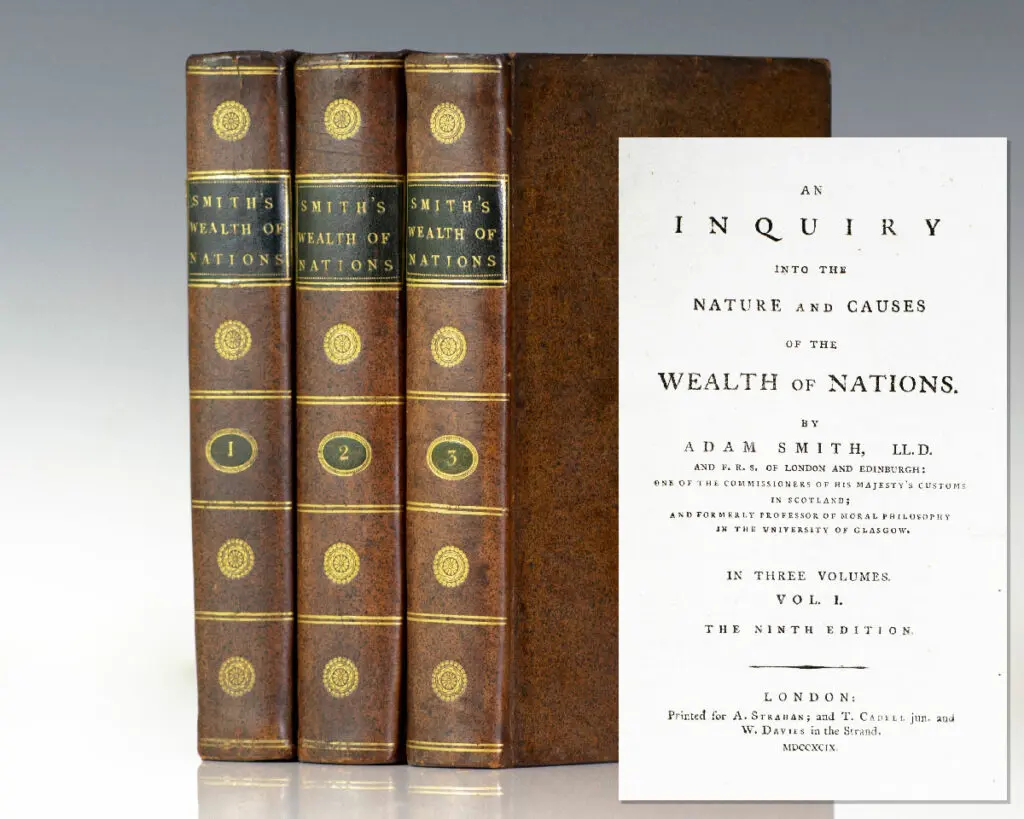
The ninth edition of An Inquiry into the Nature and Causes of the Wealth of Nations; published in 1799
Influence on Economic Thought
The influence of The Wealth of Nations spread rapidly across Europe and North America. Policymakers and economists studied Smith’s arguments as they developed new theories of production, trade, and population.
Among those influenced by Smith’s work were figures such as Alexander Hamilton, Jean‑Baptiste Say, and Thomas Malthus. Even critics of capitalism have often begun their analyses by engaging with Smith’s framework, which established many of the core questions that still structure economic debate.
In this sense, Smith did not simply contribute to economic theory—he defined the parameters of the conversation itself.
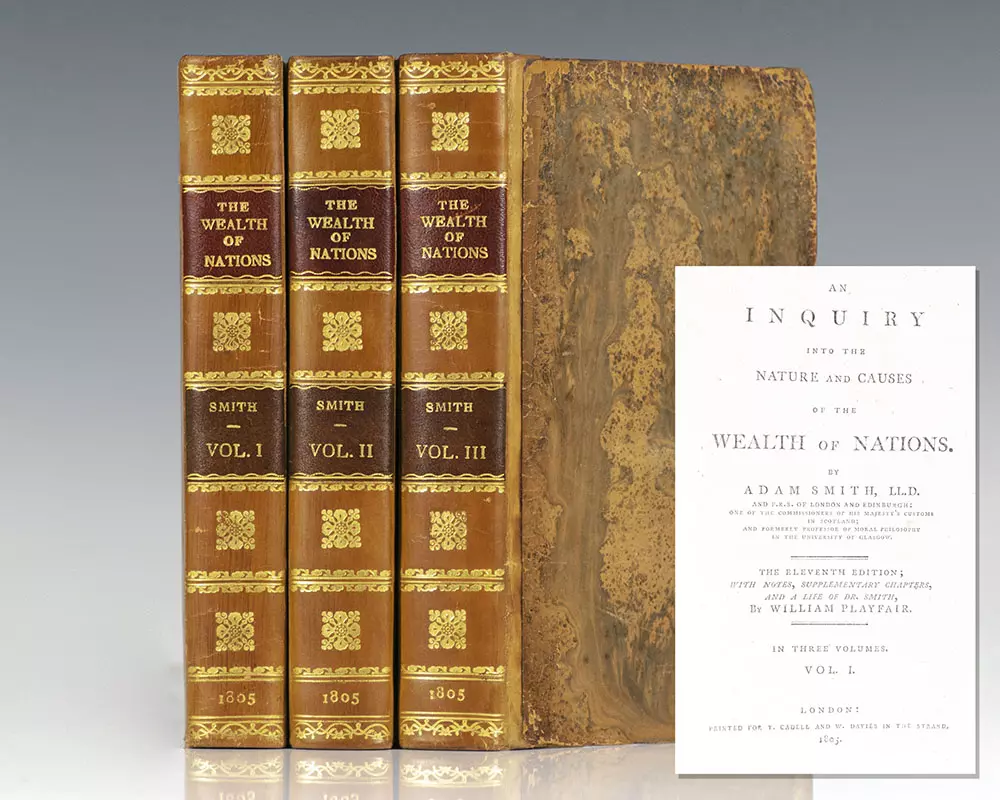
The eleventh edition of An Inquiry into the Nature and Causes of the Wealth of Nations; published in 1805
A Lasting Intellectual Architecture
Only five editions of The Wealth of Nations were published during Smith’s lifetime. Yet the ideas contained within those volumes reshaped economic discourse across continents.
Modern economic systems—whether advocating for free markets or arguing for stronger regulatory institutions—operate within the intellectual architecture Smith constructed. His work provided the conceptual vocabulary through which societies continue to debate production, exchange, and prosperity.
The Wealth of Nations did more than describe the emerging capitalist economy of the eighteenth century. It offered a theoretical structure that has guided economic thought for nearly 250 years—and continues to shape how we understand markets, labor, and national wealth today.
It is one of the strangest stories in the history of modern literature. A novel rejected by every commercial publisher who saw it. A novel prosecuted for obscenity…
It is one of the great near-misses in modern publishing history. In 1953 a forty-one-year-old schoolmaster named William Golding finished a short, strange novel about a group of…
There is a particular category of rare book that transcends the ordinary parameters of the collecting field. These are not simply early printings of significant texts they are…
Join our growing list of satisfied clients who have leveraged
our multi-cloud and hybrid cloud strategies to achieve greater
agility and efficiency in their operations.