In the News: WPB Library Foundation Yacht Cruise Has Record-Breaking Year
(WEST PALM BEACH, FL) – The West Palm Beach Library Foundation’s Cruise for a Cause set new records in number of guests aboard the yacht and in achieving…
Read moreCarl Sagan (1934–1996) was the most influential science communicator of the twentieth century—an astronomer and planetary scientist who did more than perhaps anyone to bring the wonder of the cosmos to a popular audience. A professor at Cornell University, he played a central role in the American space program, from the Mariner and Viking missions to Mars to the Voyager probes now carrying humanity’s message into interstellar space. He wrote more than a dozen books, won the Pulitzer Prize, and created the landmark 1980 television series Cosmos, seen by hundreds of millions of viewers worldwide. Below is a selection of his work in first edition—nearly all signed or inscribed—together with an extraordinary archive from the heart of his most productive years, arranged in order of publication.

This extensive archive gathers papers, letters, notes, magazines, articles, and press kits documenting Sagan’s work, assembled from the collection of Shirley Arden, his executive assistant through his most illustrious years—the era of the Viking landings on Mars, the Cosmos television series, and the Voyager mission. Arden managed his travel and publications and was close enough to the family that Sagan and Ann Druyan dedicated Comet to her and she served as matron of honor at their wedding. Sagan’s biographer Keay Davidson drew on these very documents for his 1999 life of Sagan, making the archive an unmatched window into one of the most remarkable periods in modern astronomy and the career of its leading voice.

The Cosmic Connection (1973) was the book that first established Sagan as a public figure. A wide-ranging meditation on humanity’s place in the universe, the search for extraterrestrial life, and the exploration of the solar system, it distilled cutting-edge planetary science into vivid, accessible prose and introduced the themes that would run through all his later work. Produced with the writer Jerome Agel and illustrated by Jon Lomberg, it announced a new kind of scientist—one equally at home in the laboratory and in the public imagination.

Edited by Sagan, Communication with Extraterrestrial Intelligence (CETI) (1973) gathers the papers and discussions of the first major scientific conference devoted to the search for extraterrestrial intelligence—the landmark meeting held in 1971 at the Byurakan Astrophysical Observatory in Soviet Armenia, jointly sponsored by the American and Soviet academies of sciences. It brought together an extraordinary roster of minds, among them Francis Crick, Freeman Dyson, Frank Drake, Charles Townes, Marvin Minsky, and Iosif Shklovsky. A foundational document in the history of SETI, it marks the moment the search for alien life became a serious, organized scientific pursuit.

Published as NASA’s Mariner 9 was returning the first detailed maps of the Martian surface, Mars and the Mind of Man (1973) collects a symposium in which Sagan and fellow participants—among them Ray Bradbury, Arthur C. Clarke, and Bruce Murray—reflected on how the real Mars revealed by spacecraft measured against the Mars of human imagination. It is a compact record of a pivotal moment, when the red planet passed from a canvas for fantasy into a world being explored in fact.

Murmurs of Earth (1978) tells the story of the Voyager Golden Record—the phonograph record of sounds, music, images, and spoken greetings that Sagan and his team assembled and affixed to the two Voyager spacecraft launched in 1977, intended as a message from humanity to any intelligence that might one day find it. Written with the collaborators who created the record, including Ann Druyan and Frank Drake, the book documents how a portrait of an entire planet was distilled onto a single disc now traveling beyond the solar system.
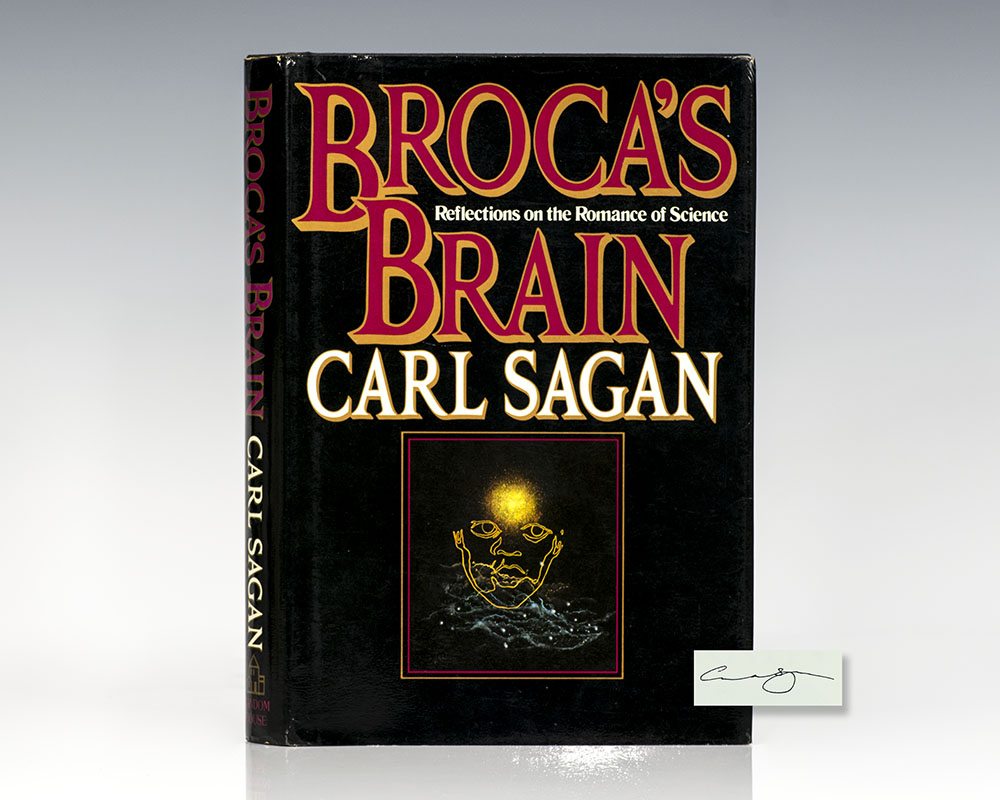
In Broca’s Brain (1979), Sagan turned to what he called the romance of science—a collection of essays ranging across the workings of the brain, the prospects for intelligent life elsewhere, the abuses of pseudoscience, and the sheer pleasure of discovery. Taking its title from the preserved brain of the pioneering neurologist Paul Broca, the book showcases Sagan’s gift for finding wonder in rigorous inquiry, and it became a best-seller that helped set the stage for Cosmos.

Cosmos (1980) is Sagan’s masterpiece of popular science and one of the best-selling science books ever published. Conceived as the companion to his thirteen-part television series—watched by hundreds of millions of people around the world—it carries the reader on a sweeping tour from the origin of the universe to the evolution of life and the future of civilization. Lavishly illustrated and written with unmistakable warmth, it defined science communication for a generation and remains the work with which Sagan is most closely identified.

Written with Ann Druyan and timed to the 1986 return of Halley’s Comet, Comet (1985) explores the science of comets alongside the long human history of awe and dread they have inspired, ranging from ancient omens to modern astrophysics. Among the most beautifully illustrated of Sagan’s books, this is the dedication copy itself, inscribed to Shirley Arden—the executive assistant to whom the authors dedicated the work.
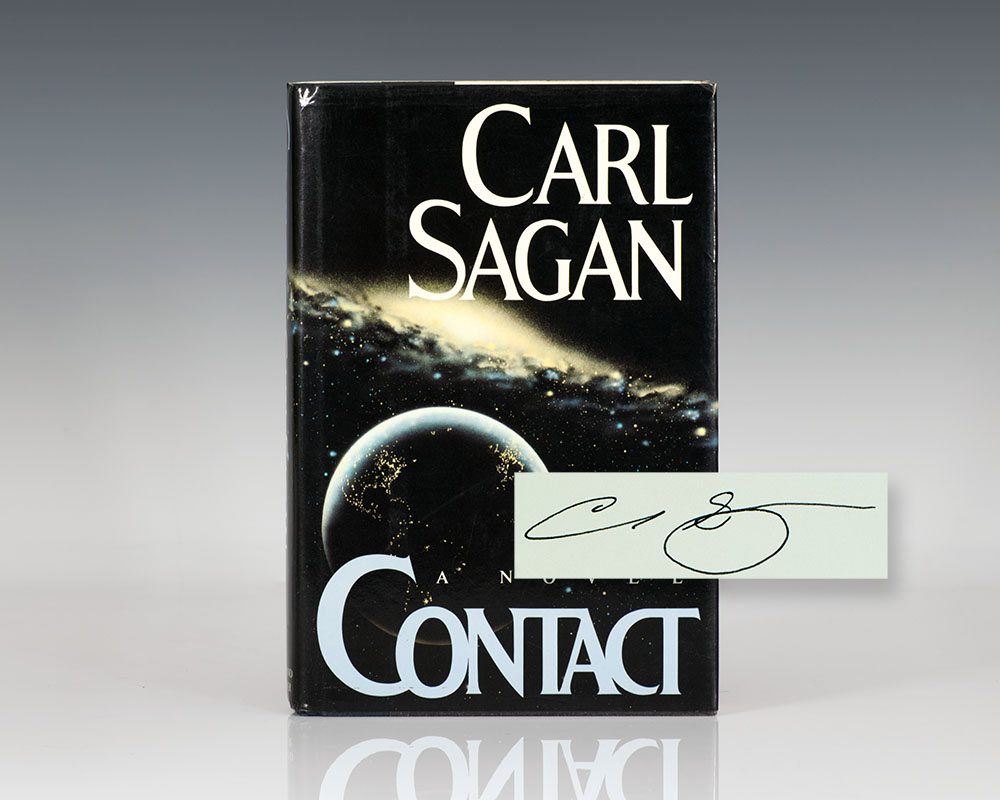
Contact (1985) was Sagan’s only novel, a work of science fiction grounded in real science that imagines humanity’s first confirmed contact with an extraterrestrial civilization by way of a message received from the star Vega. Following the astronomer Ellie Arroway, it dramatizes the questions Sagan pursued all his life—about science, faith, and our place in the universe—and was adapted into the acclaimed 1997 film starring Jodie Foster.

Pale Blue Dot (1994) takes its title and its inspiration from the photograph of Earth as a tiny speck, taken by Voyager 1 from beyond the orbit of Neptune at Sagan’s own suggestion. Part meditation on that humbling image and part argument for humanity’s future among the planets, it is considered by many to be Sagan’s finest book. Its reflection on the “pale blue dot”—our entire world reduced to a mote of dust suspended in a sunbeam—stands among the most quoted passages in all of popular science.
These first editions and the accompanying archive are part of our holdings in science and modern first editions. Explore the full collection at raptisrarebooks.com.
(WEST PALM BEACH, FL) – The West Palm Beach Library Foundation’s Cruise for a Cause set new records in number of guests aboard the yacht and in achieving…
Read moreArthur Koestler was born in Budapest on the fifth of September, 1905, and by the time he died in London seventy-seven years later he had produced one of…
Read moreArthur C. Clarke’s 2001: A Space Odyssey was written in an unusual way—hand in hand with the film it accompanies. Beginning in 1964 from Clarke’s 1948 short story…
Read more