[WASHINGTON, George].
General George Washington Kerchief 1775.
Newburgh, New York: Thornwillow Press, 2025.
$2,500.00
In Stock
Item Number: RRB-152193
+$500
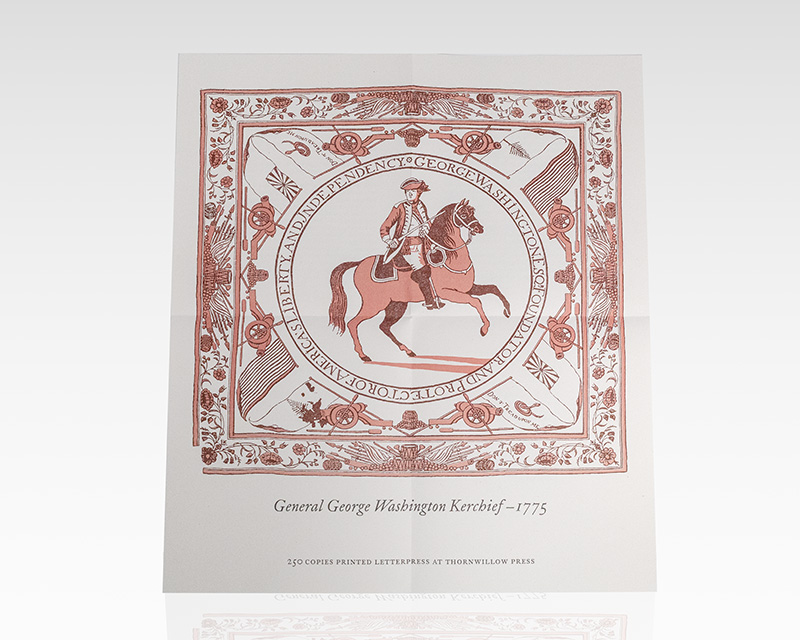
Thornwillow Press Facsimile of the 1775 General George Washington Kerchief; The First Political Textile of the United States
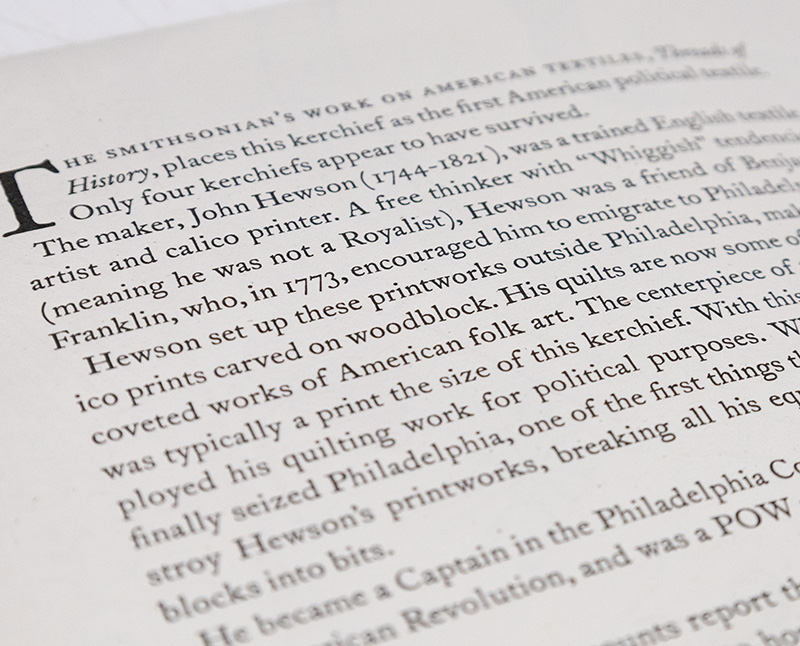
Limited-edition facsimile, one of only 250 copies printed at Thornwillow Press in Newburgh, New York. Folio, loose as issued, the kerchief reproduced in two shades of red on handmade paper, with letterpress title and colophon leaves, drawn from the collection of John R. Monsky. The facsimile faithfully reproduces the celebrated General George Washington kerchief of 1775, traditionally held to be the first political textile produced in what would become the United States. The design centers on a heroic equestrian portrait of Washington encircled by the legend "George Washington Esq. Foundator and Protector of America's Liberty and Independency"—the word "Foundator" among the earliest expressions of Washington as the founder of a nation—and is bordered with cannon, drums, stands of arms and four flags: the British Union Jack, the rattlesnake "Don't Tread Upon Me" standard, the Pine Tree flag, and a flag of thirteen stripes, all predating the official adoption of the Stars and Stripes in 1777. The original, traditionally attributed to the Philadelphia calico printer John Hewson and said to have been commissioned by Martha Washington, survives in only four known examples. The finest, from which this facsimile derives, is the centerpiece of John R. Monsky's celebrated collection of American political textiles. In fine condition. A handsome letterpress production from one of America's foremost private presses.
George Washington (1732–1799) stands as the indispensable figure of the American founding, a Virginian planter, military commander, and statesman whose character, judgment, and willingness to subordinate personal ambition to republican principle shaped the institutions of the United States at their most formative moment and established precedents for the exercise of executive power that have governed the nation ever since. Born in Westmoreland County, Virginia, into a prosperous planter family of modest gentry standing, Washington received little formal education but developed through wide reading, careful observation, and decades of practical experience the qualities of leadership, strategic patience, and institutional wisdom that defined his public career. His command of the Continental Army from 1775 to 1783, through years of catastrophic defeat, desperate privation at Valley Forge, and the grinding attrition of a war against the most powerful military force in the world, produced not a series of brilliant tactical victories but something rarer and more consequential: the survival and eventual triumph of an army and a cause that the strength of his personal authority alone held together at its most critical moments. His presiding over the Constitutional Convention of 1787 in Philadelphia, where his very presence lent the proceedings a legitimacy they could not otherwise have commanded, and his two terms as the nation's first President from 1789 to 1797, during which he established the executive branch's relationship to the legislature, the cabinet system, the precedent of a peaceful transfer of power, and the principle that no republican leader should hold office in perpetuity, were achievements of statecraft whose consequences extended far beyond the decisions themselves. His voluntary relinquishment of power at the conclusion of his second term, at a moment when he might easily have governed for life, struck contemporaries including King George III as the most remarkable act of any statesman of the modern era, and it remains the single most consequential precedent in the history of American democratic governance.
General George Washington Kerchief 1775.
$2,500.00
In Stock